In Q1 2025, I sat down to review our safety budget and spent 20 minutes staring at a number I didn't want to admit. We were 22% over plan. Not because of a major incident. Not because someone ordered a fleet of powered air-purifying respirators. We were over because of a dozen small decisions that looked reasonable at the time.
If you've ever stood under a smoke alarm chirping at 3 a.m. and asked, 'why is my fire alarm beeping,' you know the pattern. Small warnings get ignored until they become loud, expensive problems.
The Problem You Think You Have
The usual reaction is: 'Safety equipment is too expensive.' But after tracking every PPE invoice for six years, analyzing $180,000 in cumulative spending, I don't believe that anymore. The price of a hard hat or a respirator isn't the problem. The problem is how we buy.
People think expensive vendors deliver better quality. I've seen it the other way around. Vendors who deliver quality can charge more. The causation runs in the other direction.
And the same thinking applies to small things. A fire extinguisher is not a one-time purchase. It's a maintenance commitment. During an audit in 2024, we found fire extinguisher inspection tags that were two years old. Not missing. Just stale. The extinguisher probably would have worked. But the auditor didn't care. We paid the price of a re-inspection, plus the embarrassment.
The Real Causes of Overspending
1. We buy products instead of systems
A smoke detector chirping every 30 seconds is not a minor annoyance. It's a system failure waiting for a better moment. Most beeping alarms are a low-battery or end-of-life warning, not a fire alarm (NFPA 72 requires smoke alarms to be maintained per manufacturer instructions). In a commercial building, that chirp means someone has to do the work: replace the battery, clean the sensor, or replace the unit. Ignore it for a week and you get a $450 after-hours callout. I've paid that invoice.
Same with fire extinguisher tags. NFPA 10 requires monthly visual inspections and annual maintenance checks. A tag is the practical proof. If you skip it, you don't know what you have until you need it. Verify current requirements at nfpa.org.
2. The fence problem
We spent $7,200 on a woven wire fence around the compressor yard, after a driver walked through a gap that had been there for months. It wasn't a security failure. It was a maintenance failure. A fence is only safety equipment if someone checks the chain links, posts, and gates. The same logic applies to hard hats, face shields, and PAPR systems.
3. We confuse price with cost
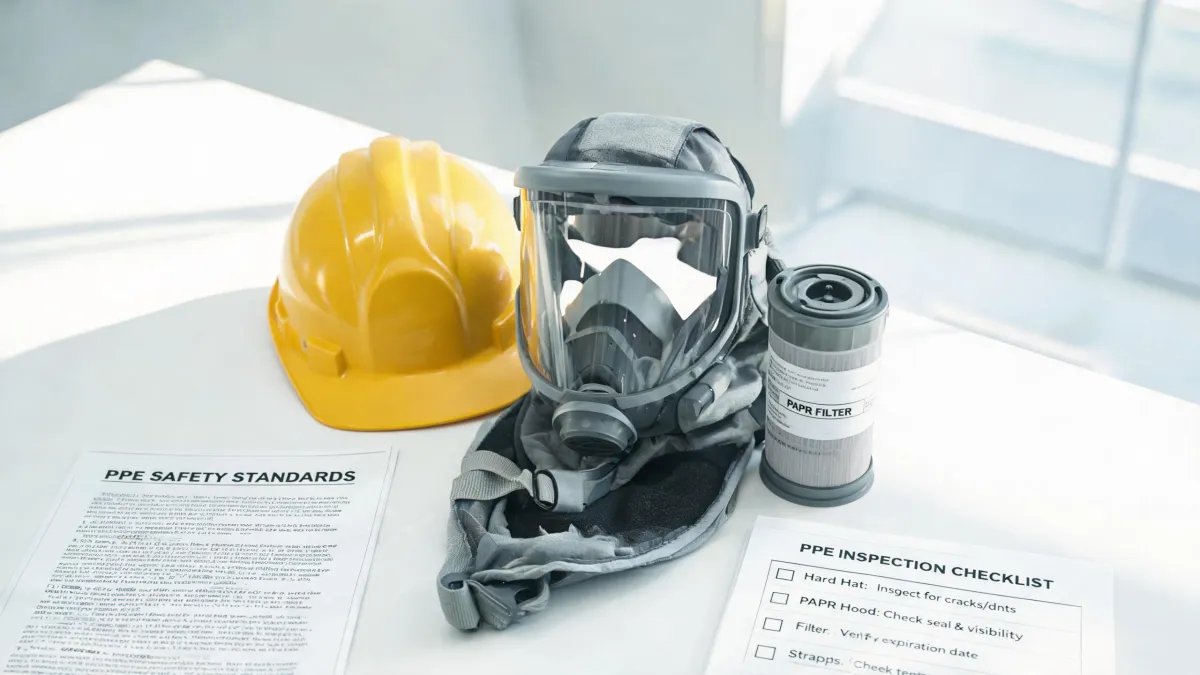
Last year, I compared quotes for replacement filters for our Bullard PAPR respirator system. One vendor was 18% cheaper. The catch? The filters weren't listed as compatible with the system's NIOSH approval. I can't say they were dangerous. I can say I couldn't verify them, so I didn't buy them. Unverified components are a liability, not a bargain.
In May 2024, one vendor quoted $6,200 for a complete set of face shields and safety glasses. Another quoted $4,900. I almost went with the $4,900 quote until I read the fine print: $300 freight, $450 handling, and no certification documents included. Total: $5,650. The $6,200 quote included shipping, handling, and the paperwork I needed. That is a 10% difference hidden in fine print.
NIOSH approval is assigned to the complete respirator system, not just the motor/blower unit (Source: NIOSH, cdc.gov/niosh/npptl). If you want a verified list, the Bullard website (bullard.com) shows approved components and service life expectations. It took me 15 minutes to check. It saved us from buying a pallet of filters we couldn't legally use in our respiratory protection program.
Also, Bullard is the company that invented the hard hat. According to Bullard's company history (bullard.com), Edward D. Bullard introduced the first commercial hard hat in 1919. That history matters less than the fact that their approvals are documented. For a procurement person, documentation is the product.
4. We ignore the cost of uncertainty
In March 2024, we had a paint booth shutdown scheduled for Monday. On Friday, I found our stock of PAPR filters was four short. The 'cheapest' option would have taken ten days to arrive. A local distributor could deliver six Bullard filters Monday morning, but charged $120 extra for the rush.
I paid it. Not because $20 a filter is a good price, but because rescheduling the paint booth would have cost $15,000 in lost production. That $120 bought certainty. Certainty never shows up on a price comparison chart.
'A maybe-cheap item is expensive. A definitely-on-time item is worth the premium.'
What This Actually Costs
Add up the typical year:
- One expired fire extinguisher inspection tag in an audit: $350 for re-inspection, plus staff time.
- One beeping smoke alarm causing an after-hours callout: $450.
- One unverified PAPR filter order that has to be returned: 4 hours of labor, shipping fees, and a week of delay.
- One fence gap that leads to a near miss: weeks of paperwork and a safety meeting nobody wanted to attend.
We didn't have a formal process for checking these things. That's not an excuse, it's a confession. After the third time the auditor flagged a fire extinguisher, I finally created a monthly checklist. Should have done it after the first time. That's the pattern. A lot of safety spending is just the tax we pay for not doing the boring stuff on time.
Some companies frame this as an operational nuisance. It's not. A missed inspection, a chirping alarm, a fence gap—these are early-warning signals. Ignore enough of them and one fails at the worst time. The cost of a serious injury is not measured in budget variances. That sounds dramatic. After six years of watching near misses and OSHA citations pile up, I'm okay with sounding dramatic.
The Fix Is Boring
If you want to stop the budget bleed, don't start by shopping for cheaper PPE. Start by finding where small warnings are being ignored.
- Walk the site and look for beeping alarms, expired fire extinguisher inspection tags, and gaps in fences. Fix those before buying anything new.
- Create a verification checklist for every safety item. For respirators, check the NIOSH approval and the manufacturer's website. For Bullard, that's bullard.com.
- Buy from vendors you can trust when timing matters. A $120 rush fee is cheap compared with a $15,000 delay. The goal is certainty, not the lowest bid.
- Budget for maintenance as part of the purchase. A fire extinguisher might cost $50; the annual inspection costs $20. Include both.
Cheap isn't a price. Cheap is a strategy that ignores total cost. The next time the alarm beeps, don't ask 'why is my fire alarm beeping' and then go back to sleep. Ask which process failed. Then fix it.
That's the difference between a budget that survives the year and one that blows up by March. You can pick which one you want. I've been on both sides.