-
When This Checklist Helps You
-
Step 1: Know Your Hazards First (Not Your Budget)
-
Step 2: Match the PPE to the Standard (Not Just the Label)
-
Step 3: Order the Right Quantity (With a Buffer)
-
Step 4: Verify the Purchase Order Details (Do Not Skip)
-
Step 5: Train the Team (Even on the "Obvious" Stuff)
-
Step 6: Audit and Adjust (Monthly, Not Annually)
-
Common Mistakes I've Made (So You Don't Have To)
When This Checklist Helps You
If you're a safety manager, HSE professional, or the person in charge of ordering safety gear for a mid-to-large industrial or construction site, this is for you. It's not about theory. It's about the six steps I follow now—after making enough mistakes to have a few firm opinions.
Step 1: Know Your Hazards First (Not Your Budget)
I said "first" for a reason. In 2022, I had a procurement director ask me to find a cheaper hard hat option. We saved $4 per unit. They were Type I, and our site needed Type II for lateral impact. The "savings" disappeared when we had to re-order everything. The only place to start is a job hazard analysis (JHA) for each role on your site.
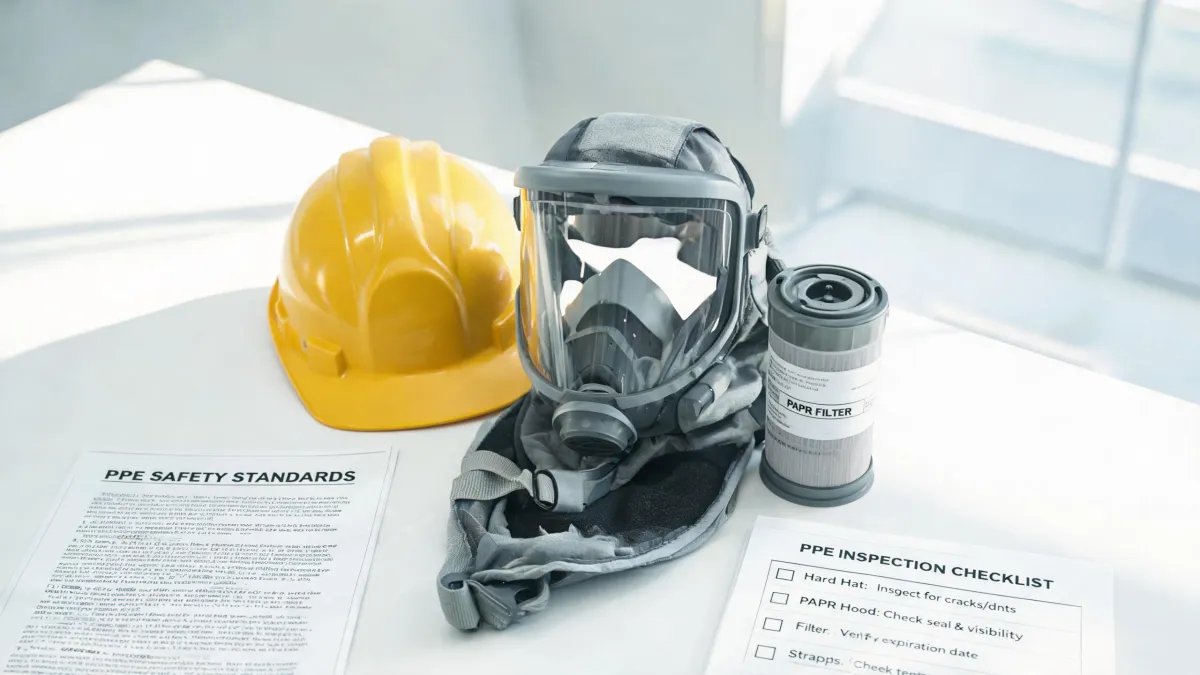
Check this: Do your employees work near electrical hazards? Then your hard hat needs to be ANSI Z89.1 Type I or II, Class E (electrical), G (general), or C (conductive). A Bullard full brim hard hat, for instance, offers that Class E rating for electrical workers—but only if you verify the specific model.
Step 2: Match the PPE to the Standard (Not Just the Label)
Here's where I learned the hard way. I ordered a batch of "NIOSH-approved" respirators without verifying the approval number. The vendor's website said it was certified. It wasn't. The Bullard EVA PAPR NIOSH approved system we later switched to comes with a clear approval number on the device and the packaging. That's what you need. Not a marketing claim.
- Hard hats: Look for ANSI Z89.1-2014 (R2019) or CSA Z94.1-15.
- PAPRs: Verify the NIOSH approval number on the TC (Testing and Certification) list at cdc.gov/niosh.
- Face shields: Need to meet ANSI Z87.1 for impact and penetration.
Reverse tip: I once assumed "same specs" meant identical safety ratings across two vendors. Didn't verify. Turned out one offered ANSI Z89.1 Type I only, the other had Type II for the same price. Always request the certification sheet with the quote.
Step 3: Order the Right Quantity (With a Buffer)
You'll never get the quantity exactly right on the first order. I try for 10-15% above what the headcount suggests, because new hires, lost equipment, and damage happen. A PPE oil filter is a good example of something you don't think about until it's clogged and you shut down a line. For disposable items, I track usage over a quarter and then set a reorder point based on lead times—not just annual usage.
My rule: If the lead time is 4 weeks, order when you have 6 weeks of stock left. The buffer covers manufacturing delays and shipping issues.
Step 4: Verify the Purchase Order Details (Do Not Skip)
I only believed this after skipping it once. I approved a PO for "hard hats, 200 units." The description didn't specify full brim. We received caps. The crew on the line needed full brim for sun and rain protection. We had to send them back. Since then, I include model numbers and a line for certification in every PO.
Here's my checklist:
- Model number (e.g., Bullard 411 Series full brim hard hat)
- Quantity and unit price
- Certification references (ANSI, NIOSH, CSA)
- Expected delivery date and shipping carrier
- Invoice format (PDF, itemized, with PO number)
Step 5: Train the Team (Even on the "Obvious" Stuff)
The best equipment is useless if no one knows how to use it. I learned this after a fire drill where three people couldn't work the extinguisher. The Bullard fire extinguisher trainer (their digital training unit) changed how we do drills. It's reusable, doesn't require real extinguisher recharging, and simulates different fire classes. We run a 20-minute session every quarter.
Key training points:
- How to inspect a hard hat (check for cracks, UV damage, and suspension wear).
- How to fit and maintain a PAPR (battery check, filter replacement schedule).
- The PASS technique for fire extinguishers: Pull, Aim, Squeeze, Sweep.
Step 6: Audit and Adjust (Monthly, Not Annually)
I used to review PPE usage once a year. That wasn't enough. In 2024, I set a calendar reminder for the first Monday of each month to check three things:
- Are any items out of stock or backordered?
- Are there any safety incidents related to equipment failure?
- Did any new standards update (e.g., OSHA 1910.134 for respiratory protection)?
One month I noticed we were burning through filters faster than expected. Turns out the pre-filter was clogging because of a new dust source from a nearby construction site. We added a pre-filter with a higher MERV rating. Problem solved. That wouldn't have been caught in an annual review.
Common Mistakes I've Made (So You Don't Have To)
- Assuming "compatible" actually works. I ordered replacement filters that claimed to fit our PAPR. They didn't. Bullard recommends only their own filters for the EVA system. That's not just marketing—it's about seal integrity and airflow.
- Not checking the invoice format. A vendor who can't provide a proper invoice (handwritten receipts? No PO references?) will cost you audit time and finance headaches.
- Ordering last year's model. Safety standards update every 5-7 years. Always verify the current standard year on the manufacturer's site.
Per OSHA 29 CFR 1910.132, employers are responsible for assessing hazards and providing appropriate PPE. The standard doesn't specify brands, but it does require that equipment meets ANSI or NIOSH criteria. That's the line I use when someone asks me to buy a cheaper alternative. It's not about me being difficult—it's about staying compliant.
One last thing: I keep a small whiteboard in the maintenance office with the current certifications listed next to each piece of equipment. It looks like a white privacy fence for a house—functional, visible, and tells you exactly what's inside. No assumptions. No surprises.