Small PPE orders deserve the same standards as bulk orders. Not "close enough." Not "it's just one unit." The same.
I know that reads like a poster nobody reads. But I'm a safety manager who's been handling PPE procurement orders for 8 years, and I've personally made and documented 14 significant mistakes—totaling roughly $16,500 in wasted budget. Now I maintain our team's procurement checklist to prevent others from repeating my errors. The humbling part: none of those mistakes happened on a big order. Every single one was an order I mentally classified as "small," "quick," or "good enough."
The $50 hard hat that cost $890
In my first year as a facilities safety manager (2019), a contractor showed up at the gate without a hard hat. The superintendent was already annoyed. I said I'll handle it. I ordered one Bullard hard hat from our regular supplier, added rush shipping, and never opened the spec sheet. I assumed a hard hat was a hard hat.
It isn't. I didn't check the suspension type or head size range. The hat arrived, the contractor tried it on, adjusted it for a few minutes, and said it would give him a headache in an hour. He left. $890 in redo costs, a one-week delay, and the original hat sat in our storage room for months.
The worst part: it was a perfectly good Bullard hard hat. Quality wasn't the problem—my process was. A one-unit order has the same suspension options, the same sizing constraints, the same certification checks as a 1,000-unit order. I treated it like a convenience-store purchase because the quantity was one.
The hard hat's origin story is a small product done right
Think about the invention of the hard hat. Edward W. Bullard invented it in 1919, after coming home from World War I. He'd watched soldiers survive impacts that would've been fatal without steel helmets, and he wanted the same protection for miners and industrial workers. His answer: the "Hard Boiled Hat," canvas, steam, and adhesive pressed into a rigid shell. One guy solving one problem for one group of workers. Not an empire. Not a thousand-unit debut.
I think about that whenever someone says "it's just a small job" or "just two guys for one day." The first Bullard hard hats were exactly that: small solutions. The size of the order never decided whether a person's head was worth protecting. It still doesn't.
The "safety glasses near me" trap
September 2022. We were putting up chain-link fence around a new equipment yard. I needed a few pairs of safety glasses for the crew and typed "safety glasses near me" into a search engine. A forty-minute drive to a real safety supplier felt like overkill for two pairs. A convenience store a few blocks away had cheap ones with a stamp that looked official. Good enough, I thought.
One afternoon of hammering fence nails, a wire fragment ricocheted off a post and hit one of the crew members square in the lens. His eye was fine—the glasses absorbed the hit. I felt relief for about ten seconds. Then I looked at the mark more closely: Z87. Not Z87.1. The difference is the high-velocity impact test. A nail moving at speed is exactly the hazard Z87.1 was designed for. My "good enough" glasses were one character away from not being rated for the actual work happening in front of me.
Here's something vendors won't tell you: Z87 is a baseline mark, but Z87.1 adds high-velocity impact testing, and the two get conflated constantly. I still kick myself for not verifying. That crew member wasn't hurt, but that was luck, not planning. And it happened because I skipped the spec check on a small order—which is exactly when this kind of shortcut shows up.
The small PAPR order that redefined "mission critical"
Q1 2021. A healthcare partner asked us to help source respiratory protection. We put together an order for Bullard PAPR systems—around a dozen units. By our standards, tiny. By the stakes, the most critical order I've ever placed.
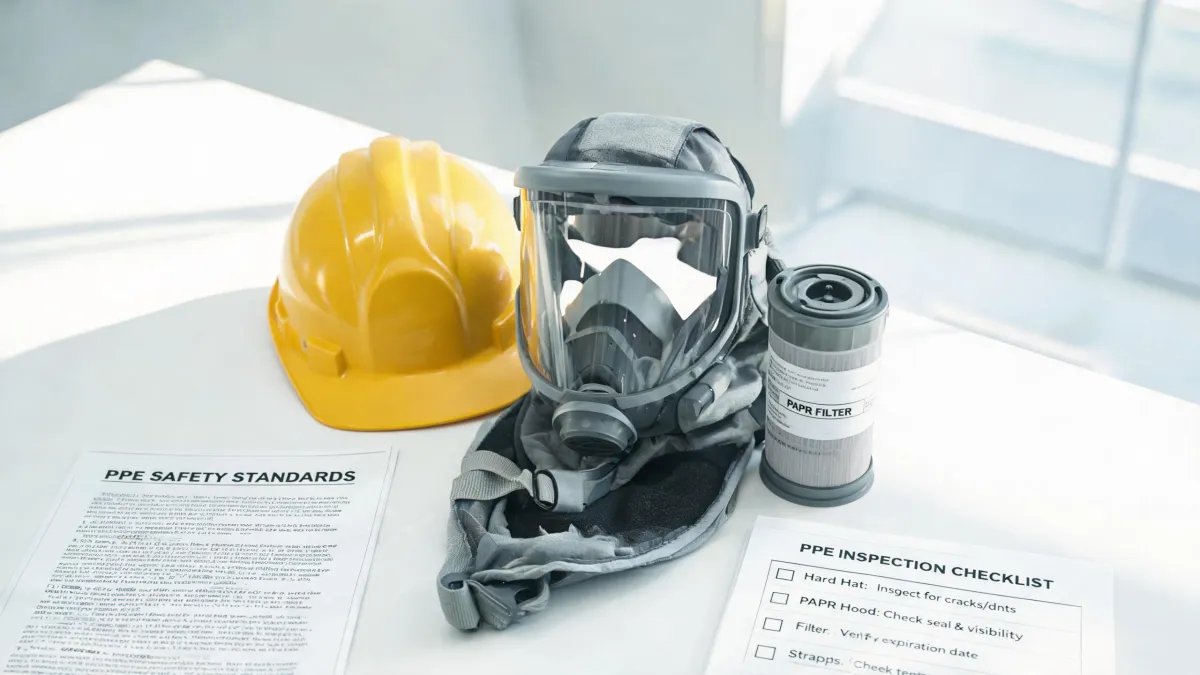
If you haven't worked with PAPRs in healthcare, here's the thing: the approval path is the entire point. NIOSH approval means the complete system was tested—filtration, airflow, battery, the works. A PAPR is a bundle: battery, blower, HEPA filter, breathing tube, hood. One missing or mismatched piece means the unit silently fails the person counting on it.
That order gave me the checklist I still use today:
- Verify the applicable standard (ANSI, NIOSH, etc.) against the hazard on site.
- Verify the model and configuration—suspension type, filter type, hood style.
- Verify end-user fit: head size, face shape, anything that affects the seal or comfort.
We've caught 47 potential errors with that checklist in the past 18 months. Maybe 45, I'd have to check the log. Most of them were on orders under $100. The small orders are exactly where shortcuts hide.
"Small orders are unprofitable"—and still non-negotiable
I'll grant the economics. A one-unit order is genuinely rough on a supplier's margin, and I've been the buyer who needed one hat overnight. With USPS first-class letter rates at $0.73 as of January 2025 (per usps.com), fulfillment overhead keeps climbing. Suppliers have the right to notice that small orders cost more to serve.
But a thin margin doesn't change one fact: a human will wear this gear. The purchase order says one unit. The person it protects is still one person. There's no quantity break that makes a skull less exposed.
The same logic applies to that annoying beep in your hallway. When millions of people search "how to stop fire alarm from beeping," the most common advice is to pull the battery. The beeping stops. So does the alarm. What most people don't realize: the beep was the device working correctly. It was telling you the battery is low or the sensor is failing. The real fix is to address the warning, not disable the system.
A small safety order is the same beep. It's the system flagging a gap: a contractor without a hat, a crew without rated glasses, a nurse without a respirator. Silencing the annoyance—by grabbing the closest "good enough" product—doesn't fix the gap. It just removes the warning.
Size sets the quantity, not the standard
Per FTC guidelines (ftc.gov), safety claims have to be truthful and substantiated. That applies equally to a 500-unit order and a one-unit order. The product, the hazard, and the person wearing it haven't changed. Only the invoice count has.
People think expensive PPE brands are about status. Actually, the causation runs the other way: organizations that take safety seriously tend to buy from companies like Bullard because decades of institutional history—Edward W. Bullard invented the hard hat in 1919—translate into documentation, certification, and consistency. The equipment is the result of the culture, not a shortcut to one.
And total cost of ownership beats unit price every time. That "cheap" $50 hard hat cost me $890 in redo plus a week of schedule slip. The savings from skipping the spec review were imaginary—now I know it.
I've wasted $16,500 learning this. You don't have to. Check the spec. Check the user. Check every time, regardless of quantity. And if you're a supplier reading this: take the one-unit orders seriously. The buyer placing a single hard hat today could be the buyer running a 400-person crew in five years—and even if not, the person wearing that single hat deserves to go home tonight. Small orders aren't the problem. Skipping standards is.