Let's start with a question I ask at every audit: How do you use a fire extinguisher?
Most people can say P-A-S-S: Pull, Aim, Squeeze, Sweep. Then I ask them to show me the motion, and the room gets quiet. That gap —between remembering an acronym and being able to act— is the same gap I see all through PPE programs.
Where I See Most Programs Fall Apart
I work as a quality and compliance manager for a PPE distributor. As of mid-2025, I review about 200 unique items a month: hard hats, bump caps, respirators, face shields, gloves, boots. I've rejected around 7% of first deliveries this year because the certification label was missing, the model was swapped, or the package didn't match the purchase order.
When something goes wrong, people say, 'But we had the equipment.' Sometimes that's true. There's a fire extinguisher cabinet by the loading dock. There are Bullard hard hats in the tool crib. There are Bullard PAPR units on the shelf. There's a stack of safety shoes ordered from Zappos or Amazon. So why are people still at risk?
Because the equipment is the easy part. Verification is the hard part.
The Label Is the Product
The first thing I check on any item is not the brand. It's the label.
A Bullard 502 hard hat is one of the most recognized models in industrial head protection. Bullard invented the hard hat in 1919, and the 502 has a history that not many products have. But if the shell doesn't carry a current ANSI/ISEA Z89.1-2014 mark, that hard hat is not a certified hard hat. It's a plastic hat. If the label is gone, the helmet is done.
Respirators work the same way. A Bullard PAPR system can be NIOSH-approved, but the approval belongs to a specific complete assembly: helmet, blower, filter, battery. Swap one component for something that's not on the approval, and the system is no longer a NIOSH-approved respirator. Search listings that combine the words 'Bullard PAPR NIOSH-approved' are easy to find. But the phrase is not the proof. The NIOSH label with the TC number is the proof.
I have mixed feelings about online safety shoe marketplaces. Zappos and Amazon make it easy for crews to get footwear, which is good. But easy buying is not the same as correct buying. I look for the ASTM F2413-18 mark on the tongue. I check whether the shoe type matches the hazard. A steel toe won't help if the hazard is a puncture through the sole.
Training Has to Be a Skill, Not a Slideshow
The other gap is training. Most people meet PASS once a year in a safety video. They nod, sign the sheet, and go back to work. Then, months later, if a fire starts, they can't remember which hand pulls the pin.
I've also seen the physical side fail. In a Q1 2024 audit, we found a warehouse with a perfectly good fire extinguisher cabinet mounted on a column. The sign above it was clear. The cabinet was behind two pallets of raw material. There was no way to reach it without moving stock first. At another site, a fire extinguisher cabinet was padlocked. The manager said they had a theft problem. I understand theft is real. But a locked extinguisher is not an extinguisher unless the key is part of every drill.
That's the part that doesn't show up on a spec sheet. OSHA's portable fire extinguisher standard, 29 CFR 1910.157, says extinguishers have to be readily accessible. A pallet in front of the cabinet is a violation, even if the extinguisher is brand new.
What a Missing Verification Actually Costs
I don't have hard data on how many injuries trace back to unverified PPE. But based on five years of audits, my sense is that 10-15% of the items I review have at least one compliance gap. Some gaps are harmless. Some are not.
The most expensive mistake I saw didn't look like a mistake. It was a missing certification document on an order of 1,200 hard hats. The product was probably fine. The paperwork wasn't. That order ended up costing $22,000 in rework and delays. For a larger operation, a 1% defect rate on a 50,000-unit annual order means 500 units could fail. In safety, that's not a statistic. That's 500 workers wearing false confidence.
The Boring Fix That Works
I went back and forth for a while about whether to push people toward authorized distributors or let them buy from any online marketplace. On one hand, budget pressure is real. On the other hand, I've seen too many deals end up with missing labels. The compromise: buy anywhere, but verify everything before it gets issued.
In 2022, I implemented a verification protocol for our own receiving process. It takes about five minutes per shipment. Since then, we've caught more than a few problems at the door instead of after someone got injured. Five minutes of verification beats five days of investigation. You don't need a complicated software system. You need a person with a checklist who is allowed to stop a shipment.
Here's the checklist I use:
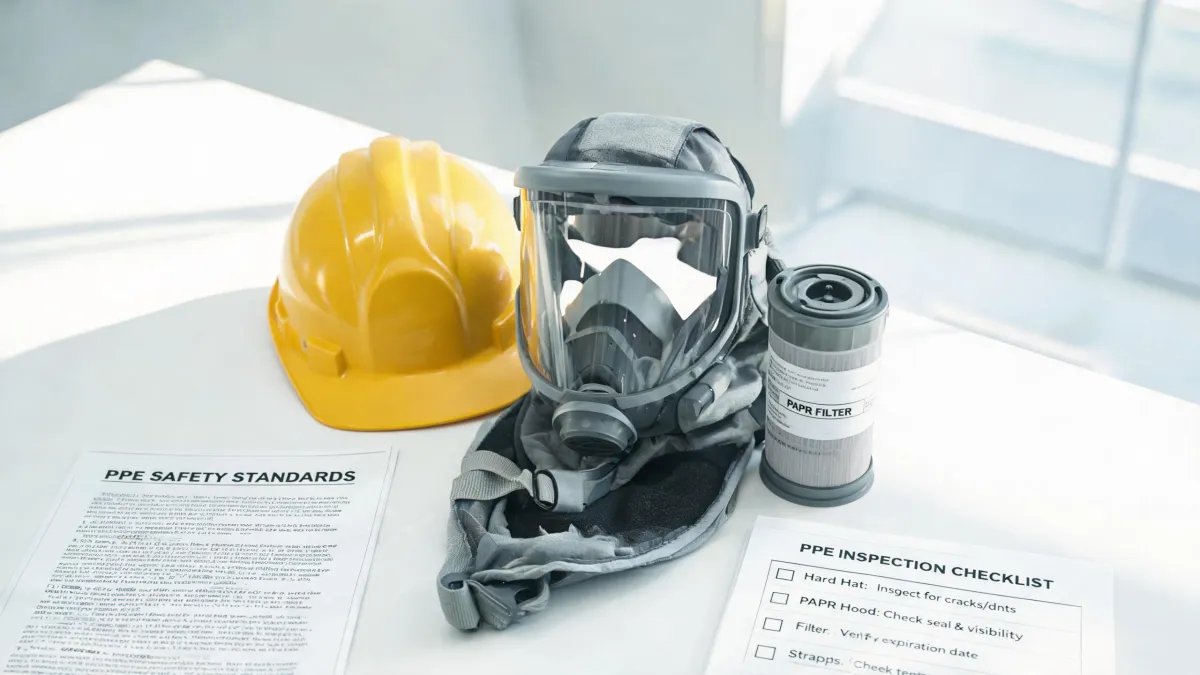
- For a Bullard 502 hard hat: check the ANSI/ISEA Z89.1-2014 label inside the shell, look for a date or lot code, and inspect for cracks, fading, or signs that someone drilled holes in it.
- For a Bullard PAPR: confirm the NIOSH TC approval number on the unit, make sure every component matches the approved configuration, and never mix in parts from a different system.
- For a fire extinguisher cabinet: make sure the latch opens easily, the gauge is in the green, the cabinet isn't blocked, and no one needs to hunt for a key to get to it in an emergency.
- For safety shoes from Zappos, Amazon, or anywhere else: find the ASTM F2413-18 mark, verify the protection type matches the hazard, and check that the soles are clean and free of damage before issue.
Then do the other half: train people until they can do it without thinking. Once a month, pull one random item and ask the team to demonstrate it. How do you use a fire extinguisher? Show me. Not just say the acronym. Show me.
Bottom line: Bullard makes serious head and respiratory protection. NIOSH-approved PAPRs are real tools. Fire extinguisher cabinets have a job. And a pair of safety shoes from a well-known website can be perfectly safe. None of that matters if nobody verifies that the right product, with the right label, in the right condition, is actually ready when someone's life depends on it.
That's the part of your safety program that no brand can sell you.