Let me start with a question I get asked constantly: can you use a fire extinguisher on a grease fire?
It sounds like a trivia question. It isn't. In March 2024, I took a call from a plant manager who had 36 hours before a regulatory audit. His internal walkthrough had turned up three employees who answered "water" when asked how they'd handle a kitchen grease fire.
Water on a grease fire doesn't extinguish it. The water vaporizes instantly, sprays burning oil everywhere, and turns a contained problem into a facility-wide emergency. The correct answer is a Class K wet chemical extinguisher—the class NFPA 10 assigns to commercial cooking oil fires. Never water. (Verify current requirements at nfpa.org.)
But what stayed with me wasn't the wrong answers. It was what the plant manager said next: "I don't know how to fix this. We bought everything on the list."
That's the surface problem. The question behind the question is the one that actually keeps safety managers up at night: Why does a fully outfitted, fully budgeted safety program still have life-threatening gaps?
Safety Is a Shopping List, Not a System
In my role coordinating emergency PPE orders for industrial plants and construction crews, I've handled more than 200 rush jobs in 12 years. When I first started, I assumed bad outcomes came from cheap equipment. That assumption didn't survive my first year. The real problem is almost never the budget. It's fragmentation.
Walk a worksite and look at what people are actually wearing. A hard hat from one manufacturer. A face shield from another. A half-mask respirator from a third. Every item has a certification sticker. And every item can be quietly undermining the others.
When Good Components Work Against Each Other
Take a popular option like the Uvex Bionic Face Shield. It's a well-made product, and I've integrated it into more than a few equipment packages over the years. But the question that never gets asked at the supply counter is whether it actually works with the hard hat and respirator that worker is already wearing.
I've watched a worker mount a Bionic face shield onto a different brand's hard hat, only to have the whole assembly shift every time he looked down. I've seen a painter who couldn't get a respirator seal because the face shield's brow guard kept pushing his mask straps off. He solved it by taking off the face shield. Then the respirator. Then he worked a full afternoon without either.
That's the counterintuitive part: individually compliant PPE can fail catastrophically when combined. The components pass their own tests. The system fails the real-world one. Sometimes the gap is visible—a quarter-inch opening between a brow guard and a hard hat brim where a spark can find an eye. Sometimes it's invisible until the worst possible moment.
The Discomfort Nobody Prices Into the Budget
Spec sheets won't tell you this, but workers vote with their feet. If a respirator is hot, heavy, or hard to breathe in, it ends up in the truck bed by 10 AM.
I used to think comfort was a soft issue—a perk, not a safety factor. Then I looked at our own order data. Last quarter alone, we processed 47 expedited PPE requests, and more than a third were replacements for gear that workers simply refused to wear. The most common replacement? Respiratory protection that didn't account for the fact that real crews work in real heat.
Comfort is not a luxury. Comfort is a compliance factor.
Why Workers Answer "Water"
The grease fire question exposes the third gap. Training that doesn't create muscle memory is decoration. A video about extinguisher classes is not the same as a hand on the trigger. When nobody rehearses the response, the brain defaults to the most intuitive answer—which, for a pan of burning oil, is the most dangerous one.
That's exactly why Bullard builds fire extinguisher trainers: they simulate a live fire and let workers feel the trigger pull and the sweep pattern in a safe environment. It turns a trivia question into a trained response. It's the difference between knowing the answer and doing the right thing when the fire is actually in front of you. Muscle memory beats intuition every time—and intuition, for a pan of burning oil, says "water."
What Fragmentation Actually Costs
Fragmented PPE isn't a budget problem. It's a human problem with a financial tail.
The Worker Who Finished "Quickly"
In July 2024, I coordinated a rush order for a crew of 18 after one of their workers was hospitalized. He was spraying solvent in a confined space. His half-mask respirator wouldn't seal under his face shield, so he lifted the shield, broke the seal, and finished the job "quickly." Two days in the hospital with chemical pneumonitis. His supervisor told me:
"We had the budget. We had the equipment. We just didn't put it together right."
That quote stayed with me. It is the single most expensive sentence in workplace safety.
The Invoice No One Plans For
OSHA classifies these as serious violations, and the penalties escalate every year. A single incorrect-PPE citation can reach five figures, with additional fines per day for uncorrected issues. Verify current amounts at osha.gov—but here's the thing: the fines are usually the smallest number on the invoice.
The real costs are lost workdays, insurance premium increases, crew hours spent on investigation and retraining, and a production line that stops because 18 workers are out. When a plant manager calls me at 4 PM on a Friday demanding Bullard PAPR systems by Monday morning, they've already done this math. The rush fee is never the expensive part. The incident is.
And beyond the measurable costs lies one that doesn't show up on any invoice: trust. When a worker sees a coworker hurt because the gear "didn't fit right," the entire crew starts treating PPE as optional. That's the most expensive culture shift a site can have.
The Fix: Build a System, Not a Catalog
Here's what I tell every client, and it fits on one slide: protection should be designed as a system, not assembled as an afterthought.
Bullard has understood this longer than most—the company invented the hard hat in 1919. And it still designs head-to-respiratory protection as an integrated set, not as parts that happen to share a logo.
Respiratory Protection People Actually Wear
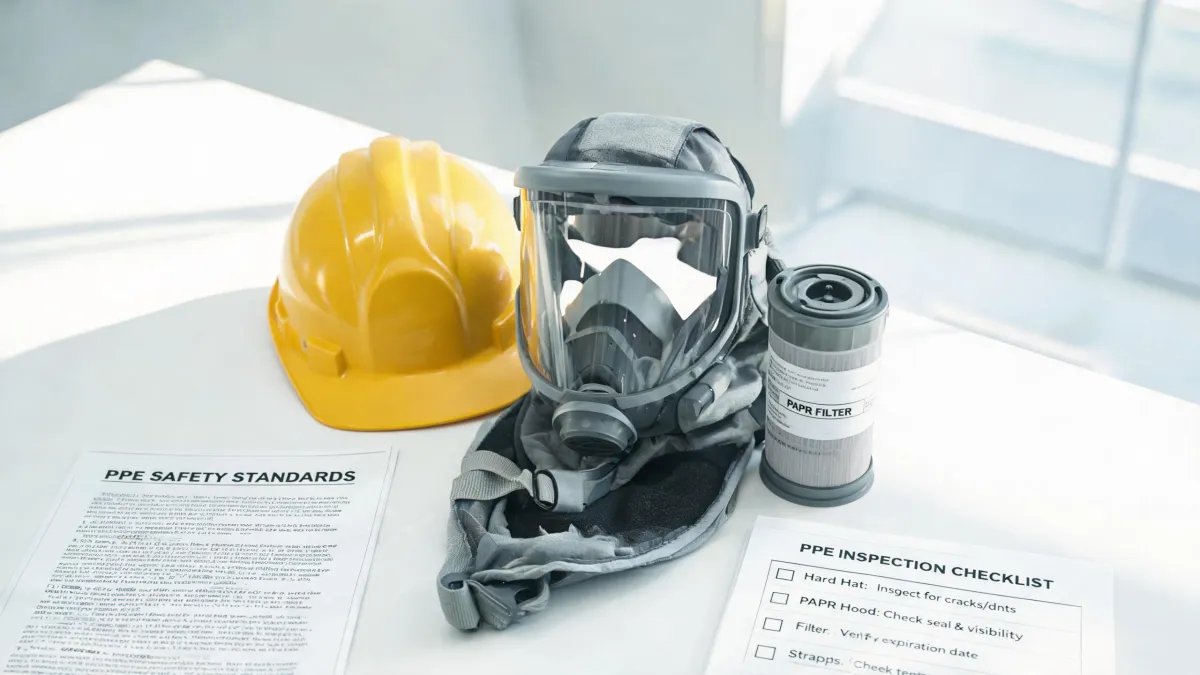
The Bullard PAPR system is the clearest example. A belt-mounted blower feeds filtered air into a loose-fitting Bullard hood respirator that covers the head and neck. Because the hood doesn't depend on a tight face seal the way a half-mask does, workers with beards can wear it, and the fit-test bottleneck essentially disappears from your program.
The NIOSH approval is worth pausing on. A NIOSH-approved PAPR has been tested as one functioning system: hood, blower, battery, filter. Not as components that happened to be in the same catalog.
Is it more expensive than a half-mask upfront? Yes. I went back and forth on that exact question with a client in April 2024. On paper, the half-mask looked like the responsible budget choice. But our usage data kept pointing the other way: people wear a comfortable hood. They leave a hot, tight mask in the truck. The client chose the PAPR system. I spent two weeks second-guessing that recommendation until their usage logs came back strong and their fit-testing passed clean.
That's the efficiency argument that wins every time: a respirator that workers wear all day protects better than a "cheaper" one that never leaves the truck.
Face Shields: Compatibility Is Non-Negotiable
The Uvex Bionic Face Shield is genuinely good—as a standalone face shield. If you standardize on it, test it with your hard hats and respirators before it reaches the field. The same logic applies to Bullard face shields: the mounting hardware is engineered for Bullard hard hats, so you don't create a gap at the exact point where a splash or spark would hit.
Put the Fire Extinguisher in Someone's Hands
And for the grease fire question, the fix is hands-on. A Bullard fire extinguisher trainer gives workers the experience of fighting a real flame without the hazards of a live discharge. When they face an actual grease fire, their hands already know what to do.
One more thing about boundaries: a horizontal fence around your site does its job by keeping the public out. Just remember that fences and PPE catalogs share a limitation. Equipment marks a boundary. Only a system protects what's inside.
The Takeaway
Every emergency call I've taken traces back to the same root cause. Not one bad product. Not one careless worker. A gap. Between components. Between training and behavior. Between what the safety program looks like on paper and what it does at 3 PM on a Tuesday.
Close the gaps, and you don't just pass the audit. You go home knowing the people on that site are protected. That's the whole point. In 12 years of rush orders and late-night phone calls, I've never once been called to a site where the fix was buying one more SKU. It's always been about closing gaps.