I manage a $180,000 annual safety equipment budget for a mid-sized industrial contractor. Seven years into this role, I've negotiated with more than 30 vendors, audited our 2023 spending line by line, and made mistakes that taught me more than any sales call.
These are the questions I hear from our project managers and from other procurement folks. There's no marketing spin here—just what I've learned about total cost, hidden fees, and choosing gear that actually works.
Is Bullard still the right brand for head protection?
Bullard invented the hard hat in 1919. That's an easy fact to toss around, but it doesn't mean today's products are stuck in the past. The industry has evolved from a hat that protects the top of your head to one that protects from lateral impacts too. Bullard's Type 2 hard hats are built for that newer standard.
In my experience, durability is where you feel the difference. I don't have hard data on how every brand wears over time, but in our rotation, Bullard shells last longer before we retire them. We've had cheaper hats lose their suspension integrity after a few months. Replacing them ate any initial savings.
Now, I'm not saying Bullard is the only brand worth buying. Some budget options meet the same ANSI Z89.1 requirements. At least, that's been the case for the few models we've tested. But when you calculate total cost of ownership, the gap gets smaller.
Should we switch to a Bullard Type 2 hard hat?
Are your crews working under overhead hazards? Around scaffolding, low ceilings, or equipment? If so, I'd take a close look at Type 2. The difference is the lateral protection. A standard Type 1 absorbs impact from above, but a bump from the side—a pipe, a beam, the edge of a truck tailgate—can still do real damage.
We changed over in 2024, after an incident where a worker caught the side of his head on an overhead door track. He was wearing a Type 1, and the top protection didn't do a thing for that sideways hit. Lucky it wasn't worse. The Bullard Type 2 we now use isn't dramatically more expensive than our old Type 1—maybe 15 to 20% more, depending on the suspension and accessories. Is it worth it? In confined spaces, definitely. For wide-open jobs, maybe not. That's a judgment call, not a blanket answer.
One thing I'd caution: a Type 2 hard hat doesn't make you invincible. It's still a hard hat, not a helmet for every possible scenario.
What do I need to know about a Bullard PAPR hood?
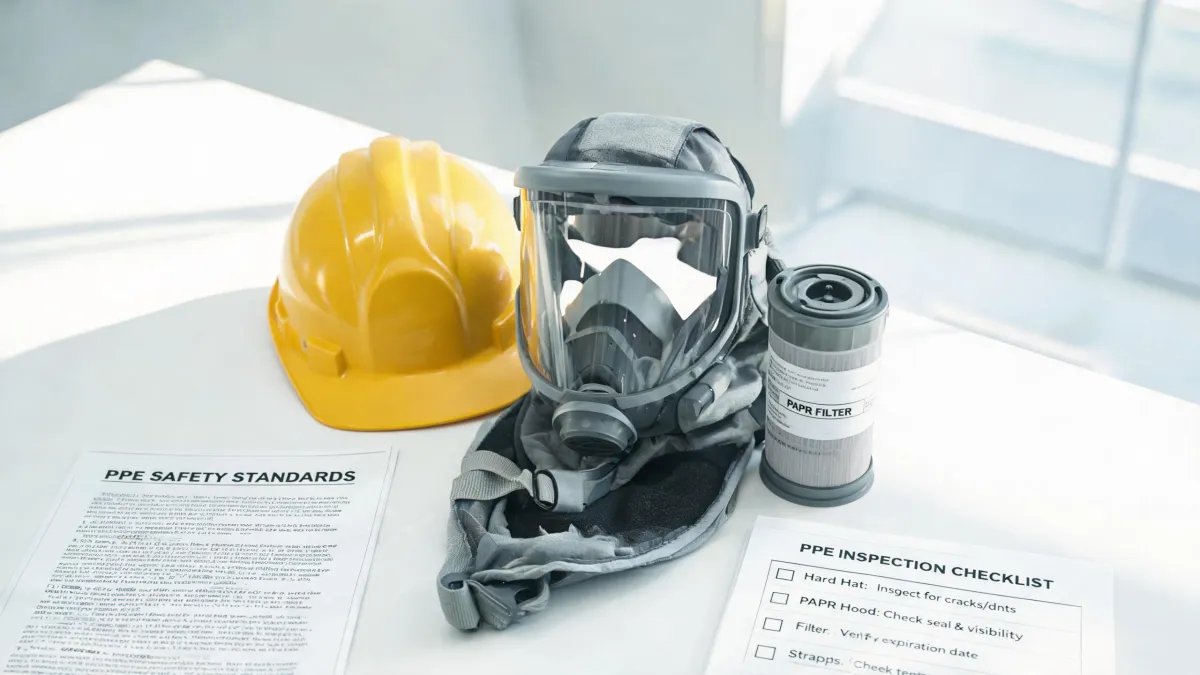
If you've only used negative-pressure respirators, the first time you put on a PAPR is a little surprising. There's a battery-powered blower pulling air through filters, so you're not working against the breathing resistance of a tight-fitting mask. The hood covers your head and face, which means less fogging and no pressure points.
The Bullard PAPR hood we use is NIOSH-approved as a system. That last phrase is important. You can't buy a Bullard hood and pair it with a different blower and call it compliant. The approval only applies to the tested combination. I've heard of people trying to mix components to save money. That's a compliance risk, and honestly, not worth it.
Cost is the first thing people ask about. Yes, the upfront price is higher than a box of N95s. But the total cost includes filter replacements, worker comfort, and whether people actually wear the thing. In our experience, crews leave PAPRs on longer because they're not taking breaks to cool down. I don't have hard data on productivity gains, but longer wear time seems like a good sign.
Water fire extinguisher or dry chemical?
Let me start with a story. In 2021, a small fire started inside an electrical panel in our maintenance shop. Someone grabbed the nearest extinguisher—a dry chemical ABC unit—and put the fire out. Great, right? Except the dry chemical powder got into the panel and corroded the contacts. We spent $2,800 replacing components. The extinguisher cost $60. That's an imbalance I won't forget.
A water fire extinguisher would have been even worse on electrical gear, so that's not the answer. The point is matching the extinguisher to the hazard. Water works on Class A fires—wood, paper, cloth. It's cheap, easy to refill, and leaves no corrosive residue. But it's useless on oil or energized electrical equipment.
Dry chemical is the versatile option: Class A, B, and C. But the residue is the hidden cost. If you're in an area with sensitive electronics, consider a CO2 extinguisher instead. And for break rooms and offices where the main risk is a wastebasket fire, a water extinguisher is perfectly reasonable. Not ideal for every spot, but workable.
What changed in our approach? We stopped buying one type for the whole building. Now we choose by zone, and we label clearly.
Does fire alarm monitoring actually reduce costs?
Our initial reaction to a monthly monitoring fee was to skip it. The building was small, the fire department was three miles away, and we had people on site during business hours. But then we priced out the worst case: a fire starting overnight in a storage room, no one to hear the alarm, and the fire department arriving 10 minutes later than they would have.
The subscription wasn't cheap. What tipped us over was the insurance discount—we saved about 12% on our property premium after switching to a central station monitoring service. Maybe it was 10%, I'd have to pull the policy. Either way, the discount mostly covered the monitoring cost. Not bad.
Modern systems don't need a dedicated phone line. Ours uses a cellular communicator, which is actually more reliable because there's no physical line to cut. Fire alarm monitoring has evolved from simple local bells to remote notification. The fundamentals haven't changed—detect the fire early—but execution is different now.
Is it worth it for every business? Honestly, I'm not sure. If you have 24/7 staff on site and no sleeping occupancy, a local alarm with automatic horns might be enough. But if you have a warehouse with inventory worth $500,000, the math changes.
How to build a chain link fence that lasts?
You wouldn't think a fence belongs in a safety equipment FAQ, but site security is part of the job. We've built plenty of chain link fences around yards and storage areas, and the first one I managed was a failure.
I tried to save money on materials by using a cheaper coated wire. Two winters later, the coating was cracking and rust showed up. The fence looked bad, but worse, the gate sagged because the posts weren't set deep enough. We had to rebuild it. Looking back, I should have paid for better galvanizing and deeper concrete footings. At the time, I was focused on the invoice.
Here's what I'd tell anyone planning a chain link fence:
- Use hot-dipped galvanized steel. The rust resistance is worth the extra cost.
- Dig post holes below the frost line and pour concrete. The post is the whole fence; if it moves, the fabric follows.
- Keep post spacing to 6–8 feet, not 10. Too much span means the top rail bends.
- Stretch the chain link tight. A loose fence is a climbable fence, and a liability.
Check local zoning codes for height limits and wind load requirements. I don't have hard data on what every jurisdiction specifies, so I always call the building department before we order materials. It's easier than redoing work.
And one more thing: if a contractor says 'we've always done it this way,' ask them to show you the current code. The industry changes, and so should we.