Here's the answer you came for: a Bullard hard hat shell should be replaced no later than 5 years from the date of manufacture, and the suspension should be replaced every 12 months from first use. That's not a suggestion from a manual—it's the line I had to learn after a $2,700 mistake on an order of 26 hard hats.
The scary part was the shells looked fine. No cracks, no dents, no weird smell. They'd just sat in a warehouse for four years before we sold them. UV, heat, cleaning chemicals, and plain old age can break down a helmet's performance before it shows visible damage.
Why this checklist exists
I've handled safety equipment orders for six years. I've personally made (and documented) 12 significant mistakes, totaling roughly $9,000 in wasted budget. Now I maintain our team's checklist so the next person doesn't have to learn the same way.
The worst one happened in 2019. I assumed 'same model' meant 'same date.' Didn't verify. I quoted a customer 26 Bullard hard hats from a lot that was already four years old. Their safety officer caught the date, rejected the whole shipment, and we ended up covering $2,700 in replacement and freight. That's when I created a pre-check list.
It took me three years and a lot of returned PPE to understand that expiration dates are a feature, not a marketing line. After six years of buying safety equipment, I've come to believe the 'best' hard hat is the one with the newest date and the least amount of guesswork.
Bullard hard hat expiration: the details
Here's how I check every Bullard hard hat now. This won't replace your own company's instructions, but it's a solid starting point.
Where to find the date on a Bullard hard hat
Bullard shells carry a date-of-manufacture marking. Sometimes it's molded into the shell, sometimes on a label under the brim. If you can't find any date, treat the helmet as expired.
The 5-year service life is the manufacturer's stated replacement point under normal industrial conditions. If it's not on the shell, check the packaging or ask your distributor. I'd rather slow down a quote by ten minutes than ship expired gear.
Shell vs. suspension: two different clocks
The shell gets the 5-year clock. The suspension—the headband and cradle assembly inside—is usually on a shorter cycle. Bullard recommends replacing suspensions every 12 months from first use. If the suspension is cracked, crusty, loose, or missing parts, replace it now, even if the shell is brand new.
The suspension is what actually transfers the impact away from your head. A hard hat with a tired suspension is basically a fancy plastic bowl.
OSHA's head protection standard (29 CFR 1910.135) requires hard hats whenever there's a risk of impact or falling objects. The standard doesn't set the replacement date—the manufacturer does. ANSI/ISEA Z89.1 also requires a date of manufacture on the shell. That's why the date matters: it's the legal starting point, not an optional detail.
As of July 2025, that's the published guidance I've confirmed with our distributor. If you're reading this later, check the current manual before relying on a blog post.
I'm not a spreadsheet evangelist, but this is one place where digital tracking wins. We've caught 47 potential errors in the past 18 months with our expiration checklist, and it cut our order rework from 5 days to 2 days on average. Efficiency isn't a nice-to-have; it's how we stopped losing money.
Here's the simple system: when we receive a shipment, we log the lot number, date of manufacture, and delivery date into a shared sheet. The sheet flags anything older than 4 years as 'expiring soon.' That little reminder gives us time to sell it accurately or swap it before it reaches a customer.
Bullard hard hat visor replacement: check the bracket, not just the part number
The second expensive lesson was with visors. I once ordered what I thought was a Bullard hard hat visor for a customer's existing helmet. It looked right in the catalog. It wasn't.
Bullard hard hat visors are made for specific mounting systems. The bracket on the cap, the way it attaches to the shell, and the visor shape all have to match. Before quoting a replacement visor, check the mounting bracket style and the hard hat model. If you're buying online, ask for a photo of the bracket. That's not overthinking it—it's cheaper than paying freight twice.
Also check the visor itself for cracks, scratches that block vision, and missing hardware. A scratched visor might still stop a splash, but if you can't see clearly through it, it's creating a new hazard.
If you're replacing a visor on a hard hat you already own, keep the original packaging or model number from the headband. The model number tells you the correct accessory family. Guessing based on the shape of the old visor is how I ordered the wrong one twice.
How to clean fire extinguisher powder (without making it worse)
Dry chemical powder cleanup is one of those jobs everyone learns by making a mess. I'm here to save you that particular mess.
Rule one: don't start with water. Dry chemical powder is designed to stay dry. When you wet it, it turns into a sticky paste that's way harder to remove and can corrode surfaces. Vacuum first.
I learned this by hosing down a storage room after a small extinguisher discharge. The powder turned into a coating that stuck to everything and took three days to clean. The dry vacuum route took about four hours.
Here's my cleanup checklist:
- Ventilate the area before touching anything.
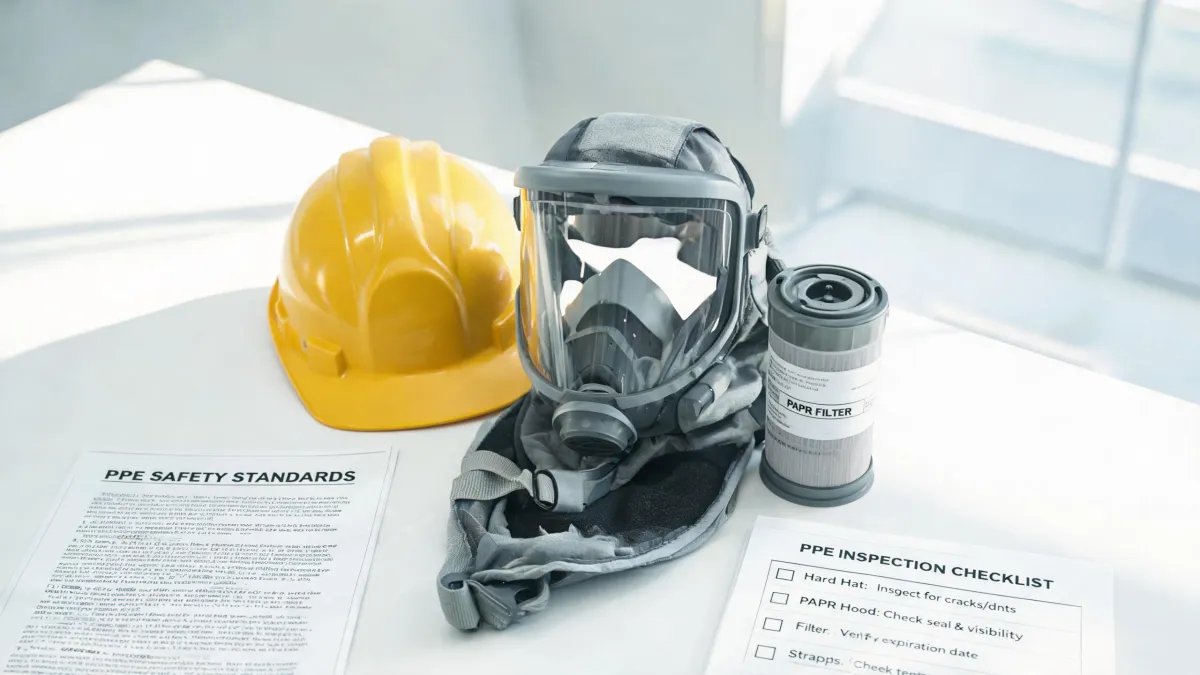
- Gear up: gloves, safety glasses, and a respirator with NIOSH-approved P100 filters. For a large cleanup, a Bullard PAPR is seriously more comfortable than an N95 that fogs after ten minutes.
- Vacuum the powder with a HEPA vacuum. Don't sweep dry powder—sweeping makes dust airborne again.
- Wipe surfaces with a damp cloth, then use a neutral cleaner (dish soap and water works) on any residue.
- Dispose of the powder according to your local hazardous waste rules. Don't wash it into storm drains.
If you're cleaning up after a training extinguisher that uses dry chemical, the same rules apply. The job doesn't care whether it was a practice discharge or a real one.
What this guide does not cover
This checklist applies to Bullard PPE in normal industrial use. If your environment has high heat, chemicals, or intense sunlight, replace it more often. If the hard hat takes a hit or falls from height, replace it immediately—no waiting for the end of the 5-year clock.
And one more thing, because I know exactly what can happen with search: Bullard doesn't make glass pool fences or electric fences for goats. Those are different safety products for different hazards. A glass pool fence is a physical barrier to keep people out of water. An electric fence for goats is a containment tool for animals. They have their own rules, and those rules are not the same as hard hat standards.
But the habit is the same: check the labeling, inspect the condition, and replace before failure. If you ended up here by accident, that's not a wasted trip—it's the right mindset for whatever safety product you actually need.
If you're not sure whether your Bullard hard hat is expired, find the date mark. If you can't prove the date, replace it. I'd rather lose a sale than help someone repeat my $2,700 mistake.