PPE Is a Decision, Not a Transaction
When I took over PPE purchases in 2020, I thought the job was simple: find a vendor, place the order, move on. I was wrong. I spent a weekend paying return freight on fire extinguisher cabinets that didn't meet code, and eventually realized that a purchase order is a safety decision.
I'm the office administrator for a 300-person industrial services company. That makes me the person who buys the hard hats, the bump caps, the PAPR hoods, and yes, the fire extinguisher cabinets. I don't design the safety program. I don't interpret OSHA regulations. But I do decide which products get purchased.
So here's my position: Buying PPE is not a procurement errand. It's a risk-management call, and the time to make it is before you need it, not after an inspection or an incident forces your hand. Most of the cost of PPE isn't the price tag. It's the cost of getting it wrong. And almost all of that cost is avoidable.
I'm writing this because I couldn't find a clear answer when I started. Most PPE content is written by manufacturers, which makes sense—they know their products. But there's very little written for the person stuck between safety's requirements and finance's budget. That's the spot I live in.
A $120 Mistake That Cost Me More Than $900
A few years ago, I ordered six fire extinguisher cabinets for a warehouse renovation. I assumed a cabinet was a cabinet. It's a metal box with a glass front, right? I picked a decent price, checked the dimensions, and approved the order. That was my first mistake.
The safety manager opened the first crate and walked straight to my desk with the spec sheet. The cabinets didn't meet the local fire code requirement for the building's occupancy rating. The inspection was three weeks away. I had to arrange return shipping, pay a restocking fee, and spend the weekend finding replacements that matched the spec. I saved maybe $120 per unit on the original order and spent close to $900 in freight and restocking to fix it. The replacement units were more expensive too, so the total damage was higher than the original savings.
The real cost was the credibility I lost with the safety team. They still double-check every order I place. I don't blame them.
That's when I learned the difference between price and cost. I also learned to ask a stupid question before placing an order: "What standard does this thing need to meet?" If you can't answer that question, you're not ready to buy. It's a little embarrassing that I had to learn this the hard way, but here we are.
Who's Responsible for Buying PPE? The Answer Isn't Obvious
People ask who is responsible for buying PPE. The legal answer is the employer. OSHA's PPE standard at 29 CFR 1910.132 requires employers to provide and pay for most PPE. But in practice, the task lands on someone who isn't a safety professional. It lands on people like me.
And if the buyer doesn't take that responsibility seriously, the consequences don't show up on a spreadsheet. They show up in an audit report or a doctor's note. I've learned to treat every PPE order like it's going to be reviewed by someone who knows more than I do—because it will be.
I'm not an industrial hygienist, so I can't tell you how to conduct a hazard assessment. That's not my lane. What I can tell you from a purchasing perspective is this: the buyer is where the compliance rubber meets the road. If I buy a hard hat that doesn't meet a recognized standard, it doesn't matter how good the company's written safety program is. The worker is wearing a non-compliant product.
Honestly, I have mixed feelings about how much responsibility that puts on a non-safety person. Part of me wishes the safety team would just hand me a spec sheet and I'd place the order. Another part knows that compliance doesn't work by delegation. If the person writing the check doesn't understand why the spec matters, the spec is just a line on a screen.
Certification Checks Are the Shortcut
The good news is that you don't need to reinvent the wheel. Certified products do the heavy lifting for you—if you verify the certification applies to the whole system.
And the verification part matters. A certificate on the supplier's website is not the same as an approval that covers what you're actually buying. I've learned to ask for the model number and the approval document, not just a screenshot.
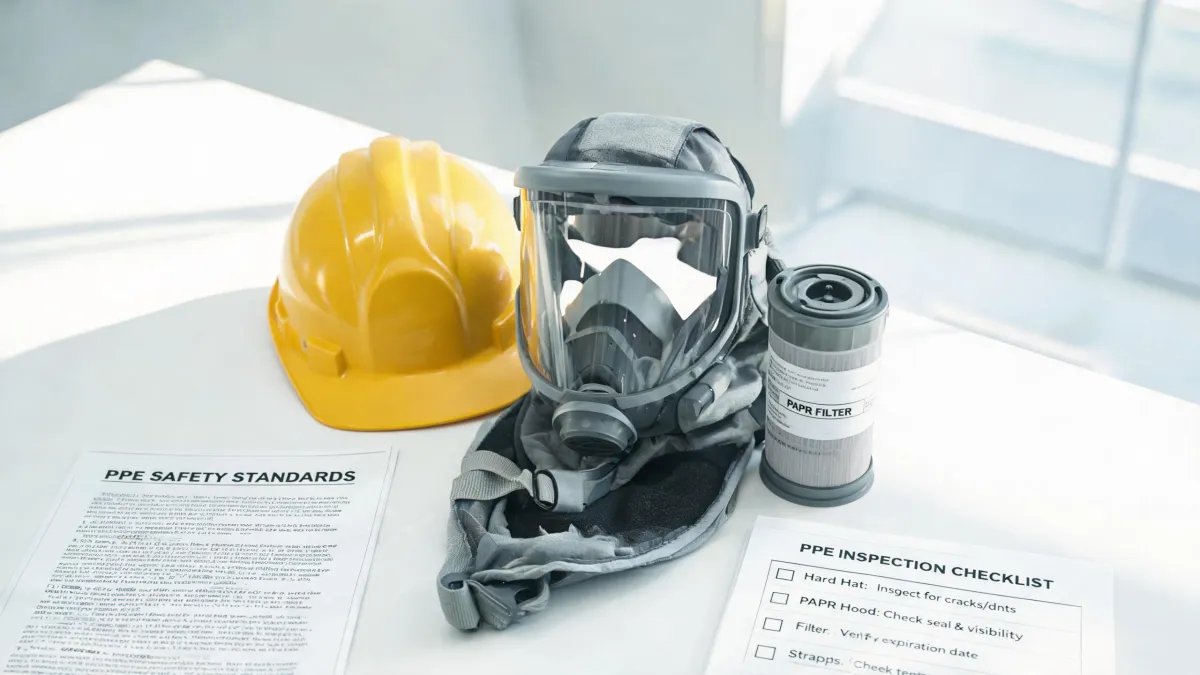
Take respiratory protection. When I evaluated the Bullard EVA PAPR for our crew, I didn't just glance at the blower unit. I checked whether the complete system—hood, blower, battery, and HEPA filters—was listed under a NIOSH approval. The Bullard PAPR hood isn't a separate accessory that you can swap in with another brand and assume it works. NIOSH approval covers a specific configured system. If you mix components from different manufacturers without verifying the system approval, you might have papered over a serious gap in protection.
Oh, and one more thing I didn't expect to care about: the company that invented the hard hat. Bullard made the first one in 1919, and they still approach certification like a safety company, not a discount supplier. When a brand treats the standard as the floor, it makes my job easier. At least, that's been my experience with the Bullard products I've ordered. Your mileage may vary, so do your own homework.
Hard hats are simpler, but not as simple as they look. A Class 2 hard hat isn't just a slightly stronger version of the basic model. It's a different engineered product, and it needs to meet a standard like ANSI/ISEA Z89.1. If your workers are in tight spaces or working around moving equipment, side impact is the thing that matters. I didn't fully understand that until a supervisor pointed out that a roof truss had swung into the side of a worker's head. The worker walked away. I'm glad I had upgraded the spec—but I should have known why before that day, not after.
What People Say When I Push Back
Look, I hear the objections. "The budget's tight." "Our old hard hats are still fine." "The supplier said it's compatible." I used to nod and place the order. Now I push back.
Budgets are real. I'm the person who watches the P&L too. But I've never seen the finance team celebrate a $2,000 savings on respirators the way they'd regret an OSHA citation. I've never seen a worker thank a company for saving $10 on a bump cap. And I've never seen a supplier put a "compatibility" disclaimer in writing. What I have seen is a supervisor with a clipboard during an audit, asking why the hard hats on the shelf don't match the hazard assessment.
There's also a weird double standard. Nobody questions a $50,000 order for a new compressor motor. But a $200 respirator gets three rounds of budget review. Then when OSHA walks in, nobody argues about the price of the citation.
This isn't about buying the most expensive brand. It's about buying the right thing, with the right certification, from a supplier who can document it. That takes an extra ten minutes on a phone call. Ten minutes is not a cost. Ten minutes is the cheapest insurance your company will ever buy. If that sounds dramatic, spend a week in my chair after the cabinet incident. You'll become a convert.
The Buy-Once Principle
I'll say it plainly: PPE purchases should be boring this time next year, not exciting. You know a PPE decision was right when nobody has to think about it again—no citations, no near misses, no "hey, why does this label look different?" orders from the site manager.
We switched our hard hats to a Class 2 spec after the truss incident. We standardized the PAPR program around the Bullard EVA system after checking the NIOSH documentation and assigning a single person to manage the inventory. We now order fire extinguisher cabinets with the municipal fire code open on a second monitor. It's not glamorous. It's better.
If you're the person who buys PPE at your company, own that responsibility. Verify the certification. Check the standard. Ask the supplier to show you the approval number. It takes minutes, and it's the easiest prevention money can buy—because most of the time, it's free.
Prevention isn't about being paranoid. It's about being prepared. The companies that do this well don't have more money; they just have a buyer who asks the right questions before signing.