Look, I'll say it plainly: I don't buy the cheapest hard hats. I buy Bullard. Specifically, I spec the Bullard C33 hard hat for most of our crews and the Bullard Above View hard hat for people who want another approved option with the same Bullard testing behind it. If you think that's overkill, let me show you the spreadsheet.
I'm the procurement manager at a 400-person industrial contracting company. For the last eight years, I've managed our safety equipment budget - right now around $220,000 a year - and negotiated with more than 30 PPE vendors. Every order goes into our cost tracking system. What I'm about to argue isn't a vibe. It's invoice math.
Hard Hats Are Not Commodities
Here's the view I've landed on: the cheapest hard hat is almost never the least expensive hard hat. The risk of compliance failures, early replacements, or a supervisor chasing down a replacement has a real dollar figure. When you add those costs together, the low sticker price is fake savings.
Most buyers focus on unit price and completely miss the cost of a non-compliant hat. In 2023, I audited our head protection spend. I found that our value-priced hard hats were being replaced noticeably more often than the models we use now. Suspension parts wore out. Shell markings faded. Workers said they didn't sit right. Put another way: the small amount we saved per hat disappeared into replacement stock and supervisor time. I might be misremembering the exact multiple, but I want to say our replacement rate was around 2.3 times higher. The real cost wasn't the replacement component. It was the stop-work time when a client safety manager flagged faded, mismatched hard hats on site. If you've ever watched a site auditor stop work because a cracked strap was visible from twenty feet, you know that sinking feeling.
Here's something vendors won't tell you: the lowest quote rarely includes lot traceability, a replacement program, or a return policy that covers a bad batch. That's not a reason to buy a fancy brand. It's a reason to ask better questions before you place the order. According to OSHA (29 CFR 1910.135), head protection must meet ANSI Z89.1. If a hard hat arrives with no markings, no lot codes, and no audit trail, you are the one who owns that risk.
Standardization Is the Real Cost Saver
Eight years ago, our PPE storeroom was a mess. Fourteen different head protection SKUs from seven brands. Different suspensions, different brim styles, different sizes. It was chaos. We now have four approved head protection types: the Bullard C33 hard hat for general construction, the Bullard Above View hard hat for crews who prefer that style over the classic C33, a full-brim style for the cowboy hat crowd, and a bump cap for low-risk spaces. That's it.
Why does a short list save money? Because when a worker needs a replacement, our stockroom finds the right part in thirty seconds. When we reorder, we know exactly which item numbers to buy. When an auditor asks for records, we pull lot codes without panic. That's the efficiency argument: fewer decisions, fewer errors, faster response. It's not even automated. It's just simple. And simple is fast.
The counterintuitive part is this: the cowboy hard hat is not a fashion statement. A full brim sheds rain, keeps sun off the neck, and makes workers more comfortable in weather that would otherwise make them want to take the hat off. Comfort is compliance in disguise. If a worker leaves their hat on the truck because water has been dripping down their neck all morning, the money you saved on a cap-style hat changes into a reportable injury very fast. I would rather spend a little extra on a brim that actually gets worn.
Certification Is an Efficiency Asset
Here's the thing about Bullard that never shows up on a price list: they invented the hard hat in 1919. That's according to Bullard's own company history, and it tells you something. They have been through a century of standards changes, injury data, and material science improvements. That, by itself, is not a reason to pay more. But it is a reason their documentation is usually in order. In procurement, documentation is efficiency.
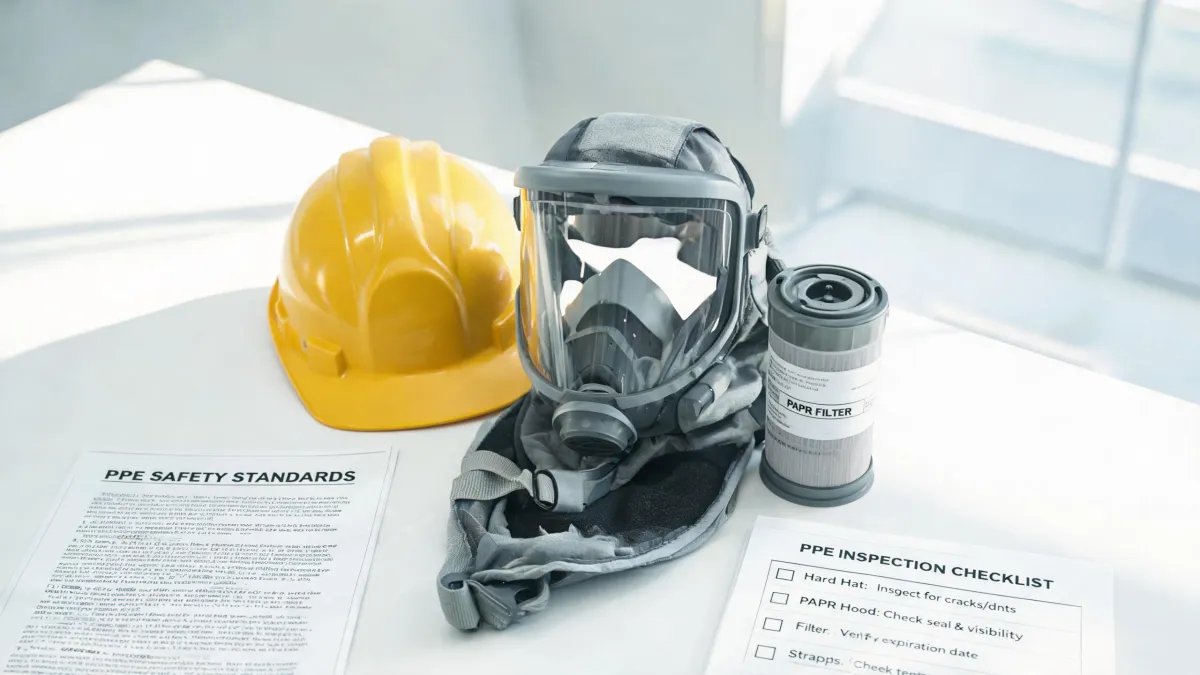
We also use Bullard's powered air-purifying respirators for some in-house operations. They are NIOSH-approved as a complete system, and I care about that because the blower, the hood, and the filters are approved together. Respiratory protection is not something you assemble from random parts. The same logic applies to head protection: we don't buy hats without clear certifications and a supply chain we can trace. Because Bullard's line covers head to respiratory, it also shortens our approved vendor list. Fewer vendor audits, fewer certificates to chase.
Now, about face protection. When our crews are grinding, cutting concrete, or doing demolition, we add the Uvex Bionic face shield to the Bullard cap. But we didn't just assume it would fit. We tested it on the Bullard suspension before making it a standard combo. A face shield that isn't compatible with the hard hat isn't PPE. It's a hazard.
And this might sound off-topic, but the same rigor applies to fire safety. People ask, “Which fire extinguisher is used for electrical fire?” According to NFPA 10, the short answer is a Class C-rated extinguisher, usually a multi-purpose ABC dry chemical or a CO2 unit. But knowing the answer is not the same as acting quickly under pressure. That's why we use a Bullard fire extinguisher trainer in orientation. It lets workers practice making that call before a real emergency. The trainer costs money. It also replaces the standard PowerPoint that everyone forgets by Friday.
Let Me Answer the Objections
“But Bullard costs more.” Yes, sometimes. On a per-unit basis, it's not always the lowest number. But when we looked at six years of total cost of ownership across our PPE program, the gap narrowed significantly. The price difference includes fewer replacements, less administrative time, and better audit outcomes. I'm comfortable paying for that.
“Can't I buy any ANSI-rated hat?” Maybe. I'm not going to name alternative brands, because some of them are fine. The issue is inconsistency. I have seen compliant-looking hard hats from the same box show up with different suspension designs and no traceable lot codes. That makes lifecycle management impossible. You do not need the most expensive hard hat in the world. You need a supplier who can answer one question consistently: What exactly is this product, and what is it rated for? Bullard answers that question clearly. Three times in a row.
Real talk: I'm not saying every job needs the exact same hat. The goal is a small set of approved options that cover the actual work. The cowboy-style brim has a place. The Above View has a place. The classic C33 has a place. And the face shield has a place. The point is that every option is deliberate, documented, and ordered from a supplier you trust.
The Bottom Line
I don't enjoy paying extra for a hard hat. I enjoy having a crew that walks on site with consistent, traceable, certified head protection. I enjoy the phone call from a site manager who says, ‘We’re ready for audit.’ There's something satisfying about a standardized PPE cage: every bin labeled, every lot number scanned, no frantic Friday call for a replacement.
So here's my position, and I'm not softening it: stop treating hard hats as a commodity. Treat them as a safety system with a total cost. The Bullard C33 and Above View are not the only good hard hats on the market. But they are the ones I will keep ordering, because the math works and the people wearing them matter.