-
1. Start with the Hazard, Not the Brand
-
2. Draw the Work Zone—Yes, Literally
-
3. Verify the Bullard Respirator Model Against Its Approval
-
4. Know What a Fall Arrest System Actually Is
-
5. Check the Physical Condition and the Whole Kit
-
6. Train at the Boundary, Not Just at the Product
-
Common Mistakes to Avoid
I'm a quality/compliance manager at a company that supplies safety equipment. I review every PPE order before it reaches customers—roughly 200 unique items annually. So far in 2025, I've rejected about 8% of first deliveries for issues like missing approval labels, incompatible filter cartridges, and harness lot numbers that did not match the test documentation. This checklist is what I run through when someone asks me to source a Bullard respirator or evaluate the Bullard EVA PAPR healthcare configuration. It also covers fall protection, because the same workers who need respiratory protection often need fall protection too.
Use this checklist if you're a safety manager, HSE professional, or procurement lead. It's six checks, in the order I'd run them. Set aside 30 minutes, and don't skip the drawing step.
1. Start with the Hazard, Not the Brand
Bullard invented the hard hat in 1919, and Bullard builds a full line of respiratory protection. That history matters. But the brand alone does not tell you whether a product is right for the hazard you have. Before you type 'Bullard respirator' into a search box, write down the exposure. Is it dust, smoke, or a bioaerosol? Is the atmosphere oxygen deficient? What is the fall distance?
If you're looking at the Bullard EVA PAPR healthcare configuration, the first question is still about the hazard. EVA is a powered air-purifying respirator designed to deliver clean filtered air. It's a reasonable option in healthcare settings where airborne particles are the concern. But if the exposure includes gases or vapors, you need a model with the right chemical cartridges, and if the atmosphere is oxygen deficient, an air-purifying PAPR is the wrong tool no matter how good the brand is.
Honestly, I'm not sure why some teams rush to the product page before they've defined the hazard. My best guess is that a familiar logo feels safer than reading an approval letter. It isn't.
2. Draw the Work Zone—Yes, Literally
This is the step I see skipped most often. Before you select equipment, draw the boundary of the work area. I call it a fence drawing. It doesn't need to be fancy. A simple overhead sketch can show where the contaminated zone starts, where the clean break area is, where workers will tie off, and where the controlled access zone ends.
Here's an analogy that works: think about a pet safe wireless fence. A pet safe wireless fence only works if the animal knows the boundary exists. You still have to put out flags, train the dog, and keep the transmitter powered. If you skip those steps, the invisible fence is just a wire in the ground. Your work site is exactly the same. If a worker cannot see where the respiratory protection zone starts or where the fall hazard edge is, the boundary does not exist.
A fence drawing also helps you spot problems before they become incidents. For example, if the anchor point is on one side of the roofline and the worker needs to move along the other side, the drawing will show the swing fall hazard before anyone climbs up.
3. Verify the Bullard Respirator Model Against Its Approval
Once you've chosen a specific model, do not trust the product title. Pull the NIOSH approval from the label or the certificate. Check the approval number, the filter type, and the limitations. The Bullard EVA PAPR healthcare units I've reviewed are NIOSH-approved systems, but that approval applies to the exact configuration you are buying, not to every accessory in the catalog.
The most errors show up here. A supplier lists a 'complete kit,' but the filters inside the box are for a different headpiece. I assumed a full kit would include the compatible battery charger. Didn't verify. Turned out the charger was a separate SKU, and the customer had less runtime than they expected on the first shift. That was not their fault; it was mine for assuming.
Per FTC guidelines, claims like 'healthcare-grade' or 'OSHA-compliant' need to be substantiated. If a distributor cannot send you the approval letter and the product-specific label, treat those claims as marketing. You want the document trail before the equipment ships.
4. Know What a Fall Arrest System Actually Is
Let's answer the obvious question: what is a fall arrest system? A fall arrest system is not a safety harness. It is not a lanyard. It is the set of components that stops a worker after a fall has already started. It does not prevent the fall. It limits the fall distance, absorbs some of the energy, and keeps the worker from hitting the ground or a lower level.
A personal fall arrest system needs three basic elements:
- An anchorage and anchorage connector rated for the load
- A full-body harness worn by the worker
- A connecting device such as a lanyard with an energy absorber or a self-retracting lifeline
Under OSHA 29 CFR 1926.502, the anchorage has to support 5,000 pounds per worker. Free fall has to be limited to 6 feet, and the maximum arresting force has to stay below 1,800 pounds. Those numbers are not optional design goals. They are the basis for choosing components that work as a system.
It's easy to get focused on a Bullard hard hat and forget that head protection does not help when someone falls off a ladder. The harness is separate. The anchor is separate. The connecting device is separate. They only become a fall arrest system when they are assembled and installed correctly.
5. Check the Physical Condition and the Whole Kit
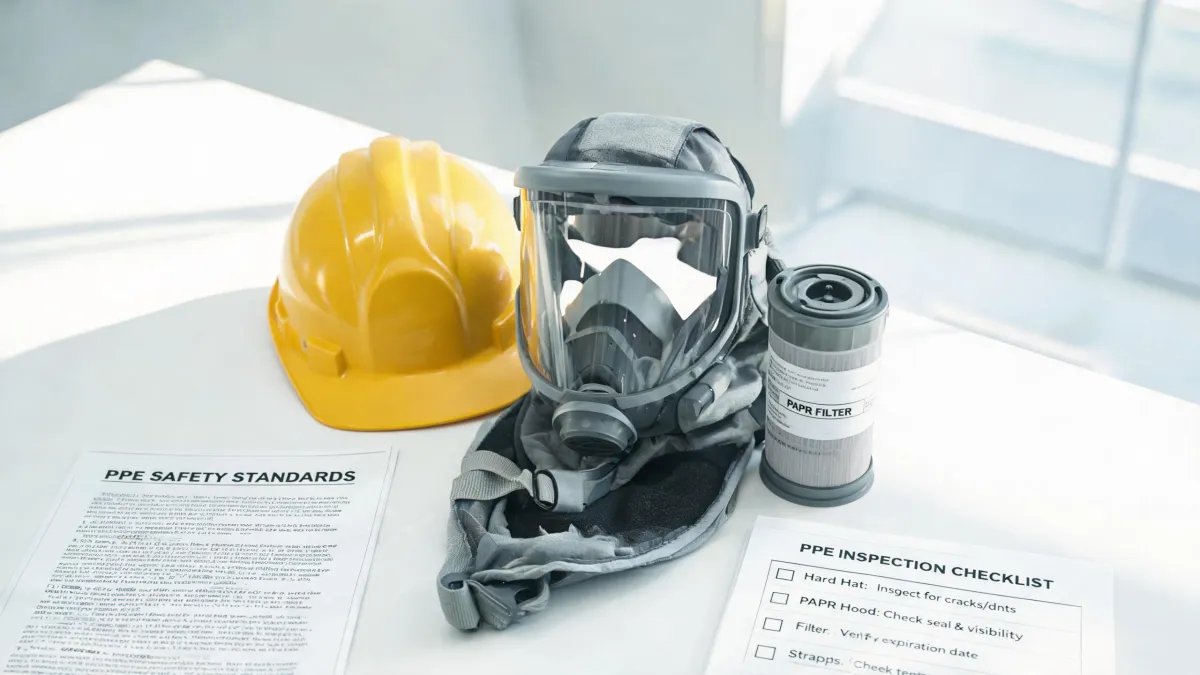
In quality review, I look at the small things before I look at the big ones. For a Bullard respirator, that means checking the battery, the charger, the airflow, the seal, the filter expiration date, and the headpiece straps. For a fall protection kit, it means checking the harness webbing for cuts, the stitching, the labels, the D-rings, and the energy absorber for signs of deployment.
I rejected a batch of eight PAPR units last year because two of them failed the airflow test. The boxes were pristine. The labels were beautiful. The internal airflow on those two units was below what the operator needs for effective protection. It wasn't visible from the outside, but it was enough to fail them.
One of my biggest regrets is not checking that a battery charger was included in a rush order. If I'd added a simple 'battery charger listed on packing slip' line to the checklist, we would have caught it before it hit the truck. That mistake still influences how I write checklists today.
6. Train at the Boundary, Not Just at the Product
Use the fence drawing from step 2 during your toolbox talk. Show people where the respiratory protection zone starts, where the fall arrest system will be required, and what to do when they move across the line. A pet safe wireless fence does not work if the dog doesn't understand the boundary. Workers are no different.
There's something satisfying about watching a crew review a fence drawing and then point out that they need a second anchor point because of the swing radius. After the stress of procurement and inspection, that is the payoff. The drawing turns the abstract system into something people can discuss and challenge.
Don't stop at the product training. The best Bullard PAPR and the most correctly rated fall arrest system are both useless if people don't know where they should be used and why.
Common Mistakes to Avoid
- Treating a harness as a fall arrest system. A harness without an appropriate anchor is just straps.
- Assuming all respirator components are interchangeable. Bullard components should be used according to the approval. Do not swap filters, batteries, or headpieces unless the manufacturer has evaluated compatibility.
- Skipping fall clearance calculations. A six-foot lanyard on a low anchor can still hit the ground before the lanyard locks.
- Forgetting a rescue plan. A fall arrest system can stop a fall, but if the worker stays suspended, that's an emergency. Suspension trauma can set in quickly.
- Storing PAPR filters where they can be crushed or contaminated. The filter's integrity is part of the protection.
Bottom line: quality in safety equipment is not about the logo on the product. It's about whether the product does what the label says, in the place where the worker actually stands. When I switched from spot-checks to a written checklist, customer complaints about missing items and compatibility issues dropped by 23% within two quarters. That's what quality perception looks like inside a company. It's not just a warm feeling about the brand. It's fewer phone calls from irritated site managers.
So if you're evaluating a Bullard respirator, purchasing a Bullard EVA PAPR healthcare configuration, or trying to answer what is a fall arrest system, run through these checks. Start with the hazard, draw the boundary, verify the approval, inspect the physical condition, and train at the edge. That's the difference between buying equipment and building a safe system.