In 2017, I was the buyer who wrote purchase orders for safety equipment. Not glamorous. But after eight years of ordering PPE for industrial and healthcare clients, I've made enough mistakes to fill a training deck. Six big ones, totaling around $14,000 in wasted budget. Maybe $13,800—I'd have to dig through the POs to be precise. Now I maintain our pre-buy checklist so other people don't repeat my errors.
The biggest lesson wasn't about price or lead times or even quality. It was about boundaries. I learned that I am not the expert on every type of protection. And I learned to distrust any vendor who claims to be.
Here's my position: If a safety purchase doesn't make you think hard about what you don't know, you haven't thought hard enough. I'd rather work with a specialist who knows their limits than a generalist who overpromises.
The PAPR mistake that rewired my brain
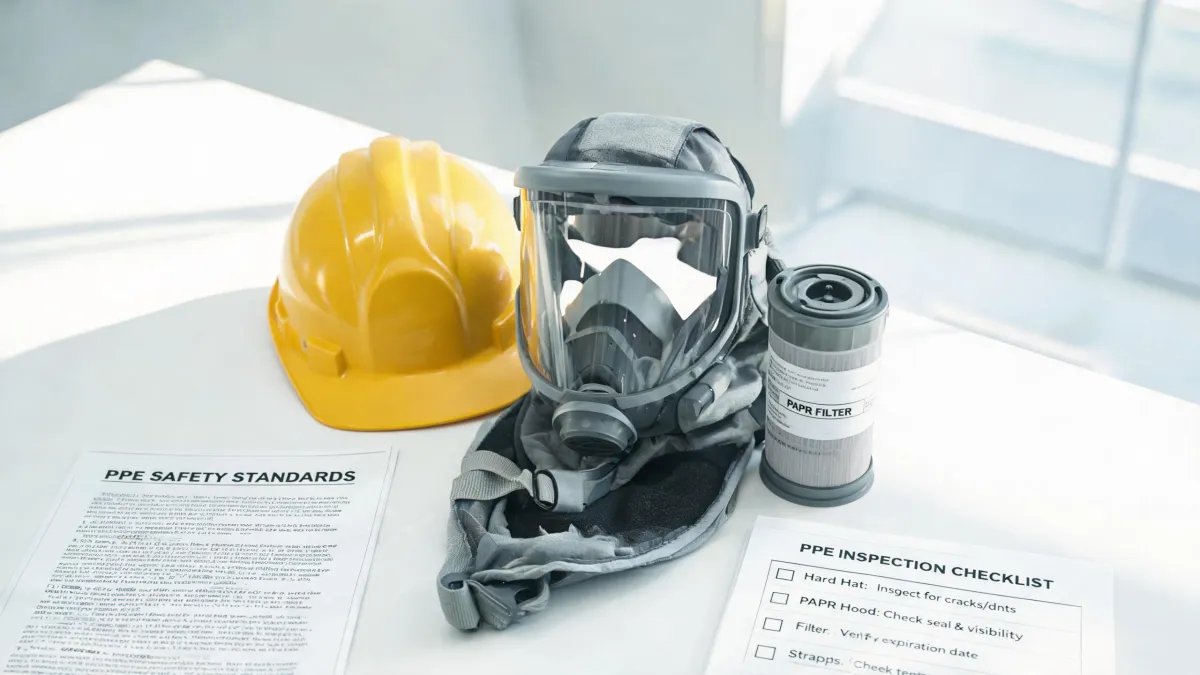
In 2017, I was helping a healthcare network put together a request for a powered air-purifying respirator system. The nursing staff needed something they could wear during infectious disease care—a battery-powered blower with a hood that would make breathing easier than an N95. My assumption was simple: every PAPR blower works with every hood. That assumption was wrong.
We almost specified a unit that paired a Bullard PAPR blower with hoods from another manufacturer. On paper, it looked fine. Both parts were certified. But they were certified as part of their own complete systems, not as mix-and-match pieces. The manufacturer's engineer caught the error during a review call and explained it in a tone somewhere between patient and horrified: mixing components voids the NIOSH approval. She said, if you want a Bullard PAPR healthcare configuration, use the Bullard components listed on the approved assembly. Or don't use Bullard at all. But don't invent your own version.
NIOSH approval under 42 CFR Part 84 applies to the complete respirator assembly. If you change a hood, a filter, or a blower, you are no longer using the approved assembly. That's not a brand preference. That's a regulatory boundary. Look it up on the NIOSH Certified Equipment List if you don't believe me.
Hard hats are not a commodity
Let's talk about head protection for a second. Bullard hard hats have a special place in safety history—Edward Bullard invented the modern industrial hard hat in 1919, and his company has been refining head protection ever since. But I don't recommend Bullard hard hats because of the historical timeline. I recommend them when the job needs what they deliver.
A hard hat has to fit, meet ANSI/ISEA Z89.1-2014 (R2019), and suit the specific hazards: falling objects, electrical exposure, overhead impact. I've watched crews throw away perfectly good hard hats because the suspension was too tight and no one had shown them how to adjust it. That's not a product failure. That's a spec and training failure.
The point isn't that every site needs a Bullard hard hat. The point is that you need a vendor who can explain suspension options, accessory compatibility, and when a bump cap might actually be a better choice than a full hard hat. If someone tells me 'all hard hats are the same,' I hear 'I haven't read the standard.'
What does a wood fence have to do with PPE?
Okay, stick with me for a second. I keep a post-hole calculator in my bookmarks because I bought a house with a slope and a stubborn soil problem. Someone recently asked me how much concrete per fence post for a wood fence. My honest answer? It depends. Soil type, post height, post diameter, frost line, wind load. The generic online guidance—one 50-pound bag per post for a 6-foot wood fence—is a starting point, not a universal rule. In loose sand, you may need a wider hole and more concrete. In dense clay, you may need less concrete and better drainage.
PPE selection is no different. The question 'what respirator do I need?' depends on the contaminant, concentration, exposure time, user fit, and task. The question 'which hard hat should I buy?' depends on your hazards, not on the logo. The shortcut is where mistakes get made.
Wait, what about Loop earplugs?
Another question I hear a lot is: Can you buy Loop earplugs in store?
I'll be honest: I don't know the current retail availability of Loop earplugs. That's not my area, and I refuse to pretend otherwise. But I do know this—if you're buying earplugs for a hearing protection program, 'can I find them at a store' is the wrong first question. The right question is what noise level is the worker exposed to, and have they been fit-tested. The most popular earplug in the world is just a piece of plastic if its noise reduction rating isn't enough for the exposure.
But isn't a full-line supplier easier?
Now, the objection I hear all the time: isn't a supplier with everything easier? Yes, simplification has value. But there's a difference between a manufacturer with a connected product line and a vendor who says yes to everything.
Bullard is a good example. They make hard hats, bump caps, PAPRs, face shields, and even fire extinguisher trainers. You could call that a full line. But the categories are connected: head protection, face protection, respiratory protection, and training tools that reinforce safe behavior. That's a focused specialty, not a general store.
Specialization shows up in honesty too. The vendor who says 'this isn't our strength—here's who does it better' earns my trust for everything else. I'd rather get an honest no than a confident yes followed by a data sheet that doesn't apply.
What I'd tell procurement teams
Ask the vendor what their product is not designed for. Ask which components are approved to work together. Ask how they handle compatibility questions. If they can't answer, that's your answer.
Bullard hard hats and Bullard PAPR healthcare configurations make sense when you need a manufacturer with documented history and NIOSH-reviewed systems. But a good specialist will also tell you when you need something else. That's not weakness. That's the entire point.
Bottom line
I don't think I'm the smartest person in the room. I'm the buyer who almost built a non-certified PAPR on a $3,200 order. I'm also the guy who spent a weekend calculating post holes because I didn't trust the shortcut. What I've learned is that expertise has a boundary. The moment a vendor says 'we can do everything,' I start looking for the exit.
I'd rather work with a specialist who knows their limits than a generalist who overpromises. It's not the comfortable answer in every procurement meeting. But it's the one that has kept me from making mistake number seven.