It was 2:47 a.m. on September 5, 2023, when my phone lit up. Our facilities manager, Dave, had sent a video from the third-floor mechanical room — the fire alarm was screaming, and there wasn't a soul in the building.
I'm the procurement manager at a 240-person industrial coatings manufacturer. I handle a $182,000 annual MRO and safety budget. And at that particular moment, I was standing in my kitchen in a bathrobe, calculating how many hours of production we were about to lose.
By the time I got to the plant, the fire department had already cleared the building. No fire. What set off the alarm was a dirty photocell — dust buildup on the smoke detector lens. Thirty-one minutes of downtime, two full shifts of overtime, and a safety committee meeting I'm still hearing about.
But here's the part that stung. I pulled up the manufacturer's instructions in our Honeywell product manual — the one that came with the detector — and it specified annual cleaning. We'd installed those units in 2020 and hadn't touched them since. That's when I realized the problem wasn't our equipment. It was our buying.
At the time, people kept asking me this question — why is my fire alarm going off for no reason? — and I figured out the answer isn't mysterious. The reason is almost always maintenance, and maintenance is almost always the line item everybody cuts.
The $4,800 problem that cost $22,000
When we renewed our fire service contract in 2021, we were offered two tiers. Basic inspection ran $4,800 a year: visual check, battery test, report. Full service ran $9,600: everything in basic, plus detector cleaning and sensitivity calibration.
I picked basic. Saved $4,800. Hit my quarterly number and moved on.
Then September happened. Thirty-one minutes of downtime, two shifts of overtime, plus the fire department's response fee — $22,000, all told. And that doesn't count the recertification work, or the six weeks I spent convincing our plant manager that this wouldn't happen again.
The thing is, the basic contract didn't say "we skip the cleaning." It just didn't say we did it. And I didn't read carefully enough to notice the difference.
Total cost of ownership isn't a line item on a quote. It's a line item on your P&L, two years later, at 2:47 in the morning.
Then the hard hats started falling off
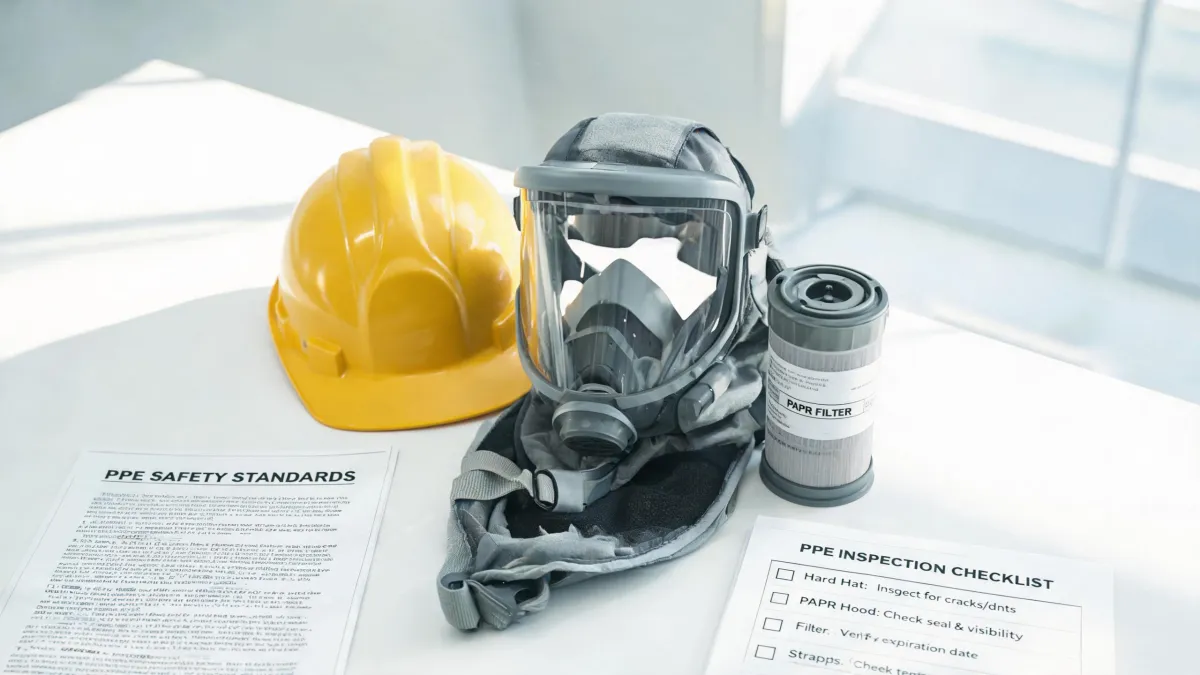
In April, we replaced the hard hats for our loading dock crew.
I pulled up the PO history. April 17 — no, April 24, I'm mixing it up with the respirator order. A standard shell, $7.80 each, brim and crown and impact protection all in. Honestly, for general site work, that's fine. Nobody was complaining about the protection itself.
The problem was the chin straps. We didn't buy them. The $7.80 model didn't come with one, and the version that did was $9.20. A buck forty more per hat, times 34 hats — call it $48.
Here's what I didn't think about: the loading dock is outdoors, on an elevated platform, and wind kicks up off the trucks. Over the next five months, at least six hats came off people's heads. Three went straight into the rain gutter beside the dock.
(Should mention: our turnover on that crew is high. Half the guys wearing those hats in September weren't there in April.)
Each time a hat went down, the dock stopped. Retrieval, safety conversation, paperwork. Six events added up to roughly $900 in lost labor, plus the replacement cost, plus one shipment that slipped to the next day because a guy wouldn't work without a hat.
That's when I started digging into hard hat with chin strap options for real — not just as a spec line, but as a wind-management tool. Turns out OSHA's own guidance flags chin straps as important for anyone working at height or in windy conditions. Not mandatory in every case. But if you've got a 25-mile-an-hour crosswind on a loading dock, "optional accessory" is a weird thing to label a buckle.
Forty-eight dollars versus nine hundred. I knew the math. I just hadn't asked the question.
The compressor room
Around the same time, we ran a noise survey on the shop floor.
The compressor room hit 94 dBA at the operator station. Under OSHA 1910.95 — the standard people usually call the hearing protection act — once you cross 85 dBA on an 8-hour time-weighted average, you're required to have an effective hearing conservation program: protection, audiometric testing, training, the whole thing.
We had a bucket of foam earplugs by the door. NRR 32. On paper, more than enough.
Then I stood there for twenty minutes and watched. Three people walked in. One put the plugs in halfway. One didn't put them in at all until he was already inside. The third took his out at the machine to hear the compressor belt.
Effective protection: close to zero.
But I didn't catch the real problem until Chris.
The comparison nobody predicted
Chris is one of our maintenance techs. I walked past the compressor room one morning and saw him adjusting something over his ears. Not foam — a headband-style muff.
He pulled them off and handed them to me. They were a pair of Honeywell R-01526 shooting earmuffs — the Howard Leight Impact Sport model, the ones with the little microphone on the outside.
He'd bought them for the range. Started wearing them at work because they fit with his hard hat and they didn't drown out everything else.
My first thought was: that can't be compliant. NRR 22. Foam is 32. That's a ten-point gap.
So I asked our safety engineer. She pulled up the spec sheet and walked me through it. Electronic muffs suppress impulse noise but amplify ambient sound below the cutoff — you can hear a forklift horn, a fire alarm, someone yelling your name. And because it's a muffed seal rather than a foam roll compressed into your ear canal, the actual attenuation tends to track closer to the rated number.
Then she asked the question that flipped everything:
"Do people actually wear them?"
Foam earplugs: NRR 32, real-world wear rate near zero. Electronic muffs: NRR 22, wear rate high because people don't have to sacrifice awareness to be protected.
The number on the datasheet had been distracting me from the number that mattered.
The best-rated PPE in the world is worthless the moment an operator takes it off to hear what's happening around them.
What changed — and what I'd do differently
We ended up keeping foam plugs as a backup and stationing muffs at the compressor room entrance and two other high-noise zones. I also built a sign-out log for hearing protection, which we didn't have before. That's the process gap piece I'd been ignoring for years: not the product, the paper trail.
We also renegotiated the fire service contract. Moved to the full-service tier. Paid the extra $4,800. Quietly, without a fight.
And here's the thing that changed how I source safety gear now. When we went out for quotes on fixed gas detection earlier this year, one distributor told us straight up: "We don't touch fire alarm systems. That's a licensed contractor's job. We sell the detectors and the calibration equipment, and we'll tell you who to call for the panel work."
They didn't get the fire alarm job. They got the gas detector order, and they'll get the next one too.
I'd rather work with a supplier who knows where their expertise ends than one who promises to cover the whole stack. Because the supplier who says "we do everything" is usually the one who quietly skips the detector cleaning and hopes you never notice.
The alarm at 2:47 in the morning was never about faulty equipment. It was about a chain of small, sensible-looking decisions — the cheaper contract, the cheaper hat, the cheaper earplug — none of which accounted for what happens six months later.
Now I ask one question before I sign anything: what does this cost us when it fails? Not if. When.
That's the number I track now.