-
What is PPE? Start with the hazard
-
The Bullard aluminum hard hat: respect history, check the job
-
Hard hat with chin strap: stop treating it as an option
-
Bullard PAPR respirator: approval is the system
-
A CO2 fire extinguisher is a tool, not a training plan
-
An updated view of PPE quality assurance
-
The bottom line
If your PPE spec is a product list you have been ordering since 2018, you do not have a safety standard. You have a purchasing habit.
I'm a quality compliance manager for an industrial safety company. I review roughly 150 model-specific PPE submittals every month before they reach customers. In 2025, I have already rejected about 7% of first-round vendor documents because the certification did not match the product model. That probably sounds strict. In safety, the detail gap between a certificate and a hard hat is where incidents start.
I am also someone who respects Bullard's history. Bullard invented the modern hard hat in 1919. The company name is still synonymous with head protection. Yet when I look at the way many companies buy PPE, I see a problem: they use memory as a specification. What was good enough for one site in one year becomes the default for every future site. That approach is outdated. The industry is moving toward hazard-specific selection, and that is a good thing.
What is PPE? Start with the hazard
The most searched phrase in this topic is also the one that gets oversimplified the most: what is PPE. According to OSHA, personal protective equipment is equipment worn to minimize exposure to hazards. Hard hats, safety glasses, gloves, hearing protection, respirators, face shields, boots, high-visibility clothing, fall protection harnesses—all are part of that definition.
But PPE is not a reward for hazardous work. It is a barrier, and it belongs at the bottom of the hierarchy of controls. The first goal should always be to remove the hazard entirely. If you cannot remove it, use engineering controls. PPE is what remains when the hazard still exists. That principle has not changed. What has changed is how much we know about fit, materials, standards, and integration.
The Bullard aluminum hard hat: respect history, check the job
If you search for bullard aluminum hard hat, you are probably looking for the look and feel of an industrial icon. I understand that. Aluminum hats have a substantial, serious appearance. And Bullard has a century of credibility behind its name.
Here is where I get unpopular: an aluminum hard hat is not automatically the right hard hat because it is old school. The selection should be based on the risks at the exact job site. If the task involves overhead impact and no electrical exposure, an aluminum shell might be acceptable. If the hazard assessment includes contact with energized equipment, a metal shell is not my first choice. You need a non-conductive shell that meets the appropriate electrical class. The hat should be chosen from the hazard, not from a photograph of the past.
I still have clients who specify aluminum hats because that is what they wore in their first jobs. I do not insult that memory. I just ask one question: if you were designing this task from scratch in 2025, would the specification include the same materials? For many of them, the answer is no.
Hard hat with chin strap: stop treating it as an option
Another product standard that needs a fresh look is the hard hat with chin strap. I used to think chin straps were only for high-angle construction. Then, during a retention audit at a one-story industrial plant in early 2024, we asked six workers to tilt their heads forward. Five hats moved more than an inch. Several came close to falling off. The location had no wind, no scaffolding, and no dramatic height. It was just a normal production floor.
A hard hat only protects you if it is on your head when the impact happens. The whole point of a chin strap is not fashion. It is retention. If you are working from a ladder, looking upward, moving quickly, or working around machinery, a hard hat without a chin strap is a hard hat waiting to become a floor object. I now recommend that companies make hard hat with chin strap a standard part of the specification, not a special order for one crew.
Bullard PAPR respirator: approval is the system
Respiratory protection is an area where the gap between old knowledge and current reality is widest. Many people search for bullard papr respirator because they know Bullard makes quality products. That trust is not misplaced. But trust needs to be verified at the model level.
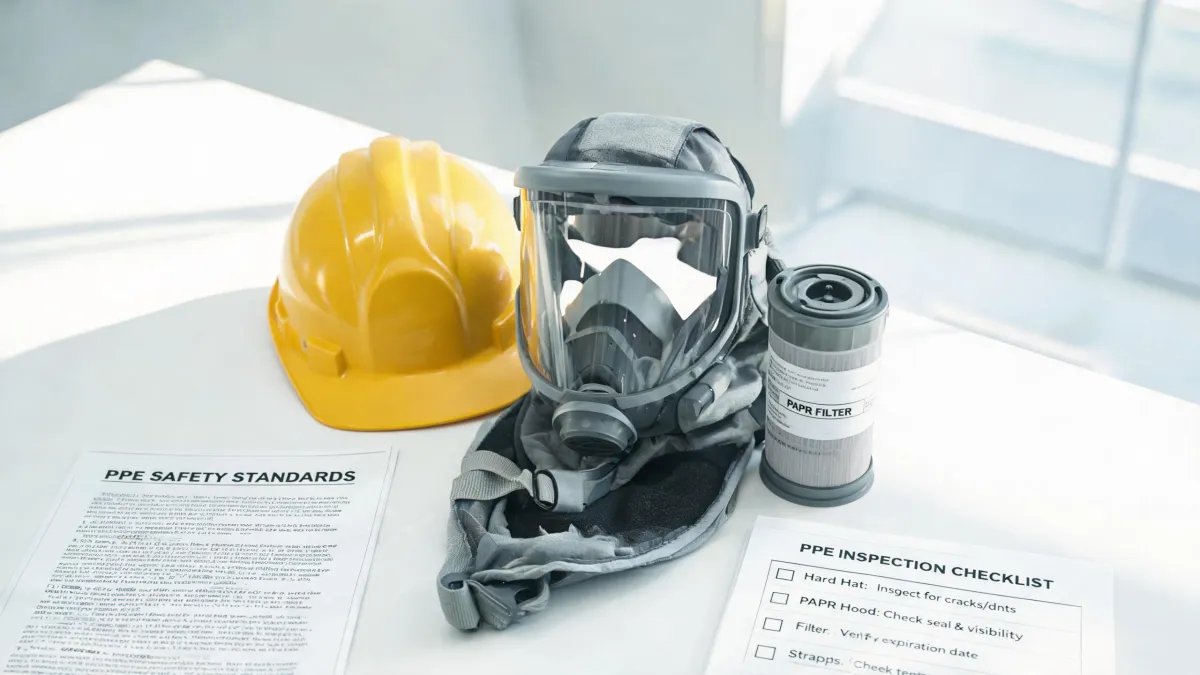
A powered air-purifying respirator is not just a blower. It is a complete assembly: motor, filter, battery, breathing tube, and headtop. NIOSH approval is given to that whole assembly. If you swap a Bullard headtop for a component that was not tested as part of the same approved assembly, you no longer have a Bullard PAPR respirator as approved. You have a homemade system with no official performance claim. In 2024, I rejected two vendor proposals for exactly that reason. They looked efficient on paper. The certification did not match the parts.
Do not let that warning turn you away from PAPR. PAPR can make respiratory protection more tolerable for workers who need it. Loose-fitting headtops are especially useful for people who cannot achieve a tight seal with a conventional mask, and increased comfort often improves compliance. The truth that matters: a respirator only protects when it is worn and maintained.
A CO2 fire extinguisher is a tool, not a training plan
The phrase co2 fire extinguisher usually pulls up hardware searches. It also shows up in fire safety conversations, and I think it belongs in the updated PPE conversation because emergency response is part of worker protection.
A CO2 extinguisher is the right tool in specific situations. It works on Class B flammable liquids and Class C electrical fires, leaves no residue, and does not damage sensitive equipment. It is not universally the best extinguisher for every fire class, especially ordinary combustibles where a different agent may be more effective. More importantly, the best extinguisher in the building is still only as effective as the training of the person using it.
That is why I support the shift toward simulated fire extinguisher training. Live CO2 discharge creates noise risk, frostbite risk, and oxygen displacement in small spaces. Simulated trainers let people practice the aiming, sweeping, and decision-making without filling the room with carbon dioxide or dry chemical. Bullard's digital fire extinguisher trainers are a good example. It may seem strange that a company known for head protection makes training systems, but it makes sense when you view the brand as a safety partner instead of just a hat maker.
An updated view of PPE quality assurance
Here is the quality manager part of my brain. When a new product arrives, I look at three things before anything else: the exact model number on the label, the standard it claims to meet, and the supporting certification document. If those three do not align, the product does not go into stock. Period.
Certificates are not bureaucracy. They are how you prove that a product works the way the manufacturer says it works. If a supplier cannot produce a valid test report before the order, that is a red flag. Waiting until after delivery makes problems harder to fix and more expensive.
The bottom line
The question what is ppe has not changed much. PPE is equipment worn to minimize exposure to hazards. What has changed is the equipment itself and the way it should be selected. The fundamentals of protection—impact absorption, retention, clean air, visibility, and judgment—remain the same. The execution should not.
I still specify Bullard products. The company has done more for head protection than almost anyone else. But I do not specify by nostalgia. I specify by hazard, standard, and documentation. If you are still using last decade's product list as your safety program, the most valuable update is not a new catalog. It is a new method.