-
Who This Checklist Is For (And What It Will Save You)
-
Step 1: Verify the Product Series and Generation—Not Just the Model Name
-
Step 2: Match the Headgear to the Application (Don't Assume One Size Fits All)
-
Step 3: Verify Respirator Compatibility—PAPR Is Not a One-and-Done Item
-
Step 4: Test the Fit Before Scaling the Order—Physically
-
Step 5: Check the Warranty, Shelf Life, and Storage Requirements
-
Common Mistakes to Avoid (The Ones I've Made So You Don't Have To)
Who This Checklist Is For (And What It Will Save You)
If you're a safety manager, HSE professional, or procurement person tasked with ordering Bullard PPE—hard hats, bump caps, PAPR systems, you name it—this is for you. I've been handling PPE procurement orders for five years now. I've personally made (and documented) 22 significant mistakes, totaling roughly $18,000 in wasted budget. That's not counting the delays, the re-shipping costs, or the embarrassment of explaining to the site supervisor why the new hard hat lights wouldn't fit the older suspension system.
This checklist has five steps. Follow them in order, and you'll catch the errors I missed. I maintain our team's pre-order checklist now, and in the past 18 months, we've caught 47 potential issues using it.
Step 1: Verify the Product Series and Generation—Not Just the Model Name
This is the mistake I made most often in my first year (2017). I'd search for a "Bullard hard hat" and grab a part number, assuming it was current. Don't do that.
What you need to check:
- The specific series (e.g., Advent, Standard, or the newer 3000 series). Bullard updates product lines regularly. The Advent hard hat series, for example, has gone through multiple generations.
- The generation indicator, often a model number suffix. If you're buying a replacement suspension for an older Advent, ordering a current-gen suspension kit might leave you with parts that physically don't fit.
Checkpoint: Before adding to cart, cross-reference the product series with the Bullard catalog for the current year. If the product page says "Replaces XXXX"—read that carefully. It doesn't always mean plug-and-play compatibility (note to self: double-check this for every item).
What most people don't realize is that Bullard's product numbering changed around 2020. Parts that were standard before now have different SKUs. An old order history won't save you here.
Step 2: Match the Headgear to the Application (Don't Assume One Size Fits All)
Most buyers focus on the brand name and price, and they completely miss whether the gear is suited for the specific task. I learned this the hard way on a $3,200 order of Bullard First Base bump caps.
Key checks for head protection:
- Is it a hard hat or a bump cap? Hard hats (like the Advent) are rated for impact from falling objects (ANSI Type I or Type II). Bump caps (like the First Base) are for bumping into stationary objects—they are not a substitute for a hard hat on a construction site.
- What about accessories? If you need a hard hat light, ensure the light bracket is compatible. Not all Bullard hard hats have the same accessory slot. I once ordered 50 hard hat lights that only fit the Advent, but the crew was using the Standard model. $890 in redo plus a 1-week delay, straight to the trash.
- The question everyone asks is "What's the price per unit?" The question they should ask is "What accessories are included, and which do I need to order separately?"
Checkpoint: Create a checklist for each job site. Does the task require ANSI Z89.1 Type II protection? Or just bump protection? Document it in the order notes to avoid future confusion.
Step 3: Verify Respirator Compatibility—PAPR Is Not a One-and-Done Item
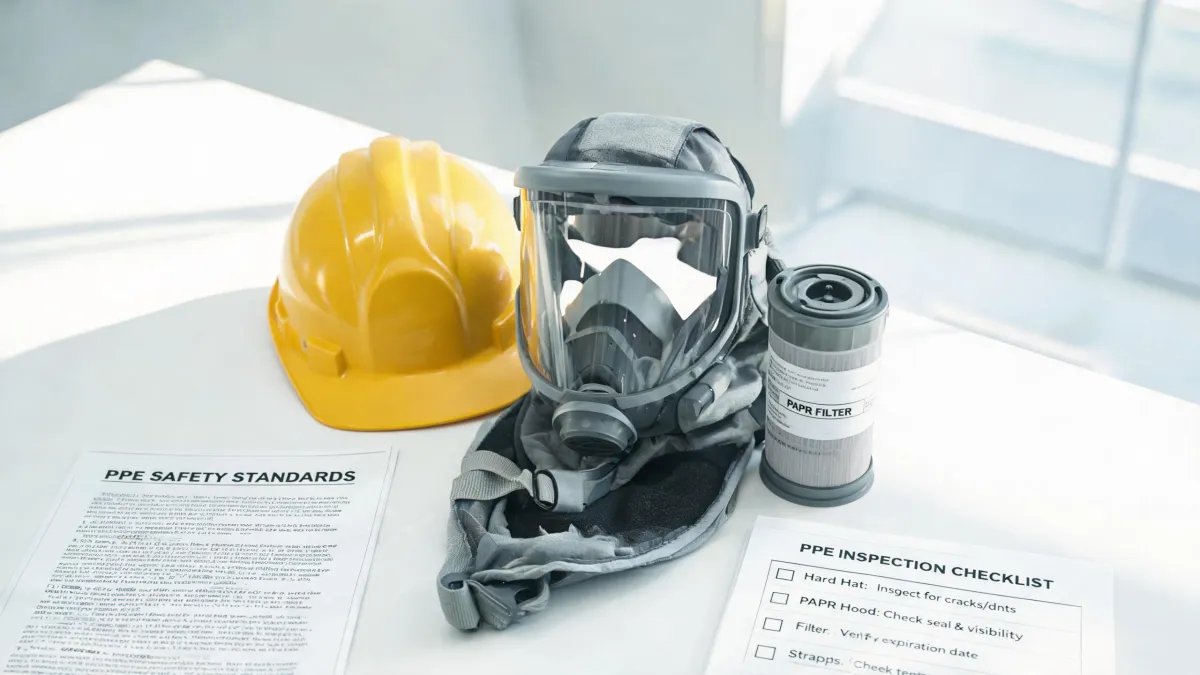
This is the area where order complexity jumps significantly. Bullard's powered air-purifying respirators (PAPR) are NIOSH-approved, but the components are system-specific.
Here's something vendors won't tell you: The blower unit, the breathing tube, the facepiece, and the filters are all part of an integrated system. Mixing components from different systems (e.g., using a generic breathing tube with a Bullard blower) can void the NIOSH approval and put your workers at risk.
What I've learned to check:
- The exact "system" name. Is it a Bullard 9000 Series PAPR? Or a newer, integrated system?
- Filter compatibility. The filters you used last year might not fit this year's model. Bullard updates filter cartridges to meet evolving standards.
- Battery type and runtime. Different applications (welding, chemical handling, grinding) demand different battery durations. If I remember correctly, we once ordered standard batteries for a lead-abatement project and ended up running out of power halfway through the shift.
Checkpoint: Look up the NIOSH approval number (usually printed on the blower or in the product data sheet). Cross-reference that with the component list. If any component doesn't match the approval, don't order it. Period.
Step 4: Test the Fit Before Scaling the Order—Physically
I still kick myself for the time I ordered 100 Bullard Standard hard hats without checking the fit on our crew. The shell was fine, but the suspension system was one size too small for about 30% of our guys.
Your pre-order test plan:
- Order a single unit first. Have at least three workers of varying head sizes wear it for a full shift.
- Check for pressure points. The suspension should be snug but not painful.
- If it's a full-face respirator (like for a PAPR system), check the seal at different work angles (looking down, looking up).
A hard truth: Even within the same brand, different models fit differently. The Bullard Advent fits differently than the Bullard Standard. The First Base bump cap fits differently than a standard hard hat. A single sample can save you $1,000s in returns.
Checkpoint: After the test, ask the crew for a thumbs up or down. One "it's uncomfortable" comment is worth ten spec sheets. That mistake affected a $3,200 order where every single item had to be sent back and swapped out.
Step 5: Check the Warranty, Shelf Life, and Storage Requirements
Most buyers focus on the initial price and completely miss the total cost of ownership. This is especially true for items like the Bullard fire extinguisher trainer or the advanced PAPR systems.
Key items to check:
- Shelf life of filters and cartridges. NIOSH-approved filters have a finite shelf life, even in sealed packaging. If you're ordering a year's supply, you might waste a quarter of it if it sits on a shelf. I once ordered a batch of P100 filters for a project that got delayed—by the time we used them, they were six months past their recommended use-by date.
- Warranty on electronic components. The blower unit on a PAPR system or the battery charger has a manufacturer warranty (often 1-3 years). Verify this before ordering, and document the serial numbers immediately.
- Where to store them. Extreme heat or humidity can degrade plastic components and filter media. OSHA and Bullard recommend storing PPE in a cool, dry place, away from direct sunlight. (Mental note: check our storage area temperature next week.)
Checkpoint: Read the fine print on the product data sheet. "Standard warranty" is not a given. Some consumables (like replacement filters) have no warranty at all. Verify and document the storage conditions required.
Common Mistakes to Avoid (The Ones I've Made So You Don't Have To)
To wrap this up, here are the three recurring errors I still see in my own team's orders:
- Assuming compatibility across product lines. Bullard hard hat lights for the Advent don't fit the Standard. Bullard PAPR filters for one generation don't fit another. Always check the catalog.
- Skipping the fit test for a large order. I can't stress this enough. A $5 sample can prevent a $5,000 mistake.
- Relying on memory or old order history. Prices change, SKUs change, and generations change. Always check the current data. (I really should update our internal part number reference sheet.)
Per OSHA guidelines and Bullard's own recommendations, any PPE—especially respiratory protection—must be selected based on a site-specific hazard assessment. A checklist is a tool, not a substitute for that assessment. If you're unsure about a specific Bullard product, their technical support (available on their website) can clarify compatibility and specifications. As of mid-2025, at least, that's been my experience.
An informed customer asks better questions and makes faster decisions. Use this checklist on your next Bullard order. It'll save you the $18,000 in mistakes I had to pay for to learn these lessons.