-
What's the real difference between a Bullard hard hat and a First Base bump cap?
-
Why pay more for a Bullard bump cap when cheaper ones look the same?
-
What's the best welding helmet for beginners?
-
When should we upgrade from regular respirators to a Bullard PAPR?
-
What's the "invisible fence" in a PPE program?
-
What does a "white picket fence" Bullard PPE program look like?
I coordinate emergency PPE orders for a living. When a safety manager calls me, it's usually because something broke yesterday—an audit's coming, a crew's down, a spec was wrong. Over the last four years, I've handled more than 200 rush orders, including same-day turnarounds for manufacturing and construction clients facing site audits the next morning.
Here are the Bullard PPE questions I actually get in those calls, with straight answers.
What's the real difference between a Bullard hard hat and a First Base bump cap?
People use the names like they're interchangeable. They're not.
A hard hat is built and certified to ANSI Z89.1—tested for impact and penetration from falling objects. If there's any overhead hazard, that's what OSHA expects to see on your crew's heads. Bullard's hard hat lineage goes back to the "Hard Boiled" hat the Bullard family created in 1919. A century later, the core job hasn't changed: protect the top of the head from things trying to hit it.
The Bullard First Base bump cap is a different tool. It's not an ANSI Z89.1 impact-rated hard hat. It's designed for workers who keep hitting their heads on fixed objects—pipe racks, low mezzanines, conveyor lines, vehicle undercarriages. It's lighter, lower-profile, and more comfortable to wear all day in a maintenance or warehouse setting.
The mistake I see: someone tries to swap a bump cap in where a hard hat is required. Doesn't fly. Bump cap for bump hazards, hard hat for falling-object hazards. Wrong tool means a citation—or worse, an injury that shouldn't have happened.
Why pay more for a Bullard bump cap when cheaper ones look the same?
Look, I'm not going to tell you cheap caps are garbage. What I'll tell you is that cheap caps have cost my clients more than they saved. I've watched this pattern repeat enough times to stop being surprised.
In March 2024, a logistics client called me two days before a corporate audit. They'd bought a couple hundred bump caps from a discount online vendor to save about six dollars per unit. Five months in, the shells were starting to bubble and the harnesses were pulling loose. The audit team flagged the whole lot. The client paid $1,200 in expedited shipping just to get compliant caps on site in time. The six dollars per cap they saved? Gone. Every dollar of it.
With bump caps, you're paying for things that don't show up on a spec sheet: shell material that holds up to heat, sunlight, and chemical exposure; a harness that doesn't stretch out after a few hundred wear hours; replacement parts you can actually order; and performance ratings that survive a third-party review.
Price is what you pay. Value is what the cap looks like 18 months later. In my experience managing 200+ orders, the lowest quote has cost clients more in roughly 60% of cases. I don't have a research paper for that number—it's just what I've seen.
What's the best welding helmet for beginners?
Straight answer: Bullard's not the first brand that comes up for traditional welding helmets—they focus on head protection, bump caps, and PAPR respiratory systems. So here's the buyer's guide I give everyone who asks.
For a beginner, the best welding helmet is the one you'll actually use. The dirt-cheap fixed-lens hood is how most people decide welding isn't for them. The pro-level auto-darkening model is overkill before you know if you'll stick with it. There's a middle ground.
Four things that matter:
- Auto-darkening lens with an adjustable shade range—shade 9 to 13 covers most entry-level work.
- A wide viewing window. If you can't see the puddle clearly, you can't weld well.
- Comfortable headgear. The cheap elastic strap will make you miserable within 20 minutes.
- Weight. A heavy hood means neck fatigue, which means bad welds by the end of the day.
And the thing beginners almost never think about: fumes. I've seen new welders develop headaches after a week of MIG on coated steel. If you're welding galvanized, painted, or dirty metal, respiratory protection isn't optional. That's where Bullard's PAPR systems come in—fab shops and shipyards use them to supply a welder's hood with clean, filtered air that also cools your face. Most beginners don't spec respiratory compatibility into their first setup. Do that.
When should we upgrade from regular respirators to a Bullard PAPR?
Real talk: a standard N95 or elastomeric half-mask works great—if it fits. That "if" is doing heavy lifting.
I recommend a powered air-purifying respirator (PAPR) when I see any of these three triggers:
- Fit test failure rates above 30%. If facial hair, facial structure, or job rotation keeps preventing a good seal, a PAPR removes the seal question entirely.
- Extended wear in hot or physically demanding work. A PAPR moves filtered air across your face. Your crew will notice the difference in the first hour.
- You need a higher assigned protection factor (APF). NIOSH-approved PAPRs give you a significantly higher APF than a half-mask, which matters when air sampling data says you need the margin.
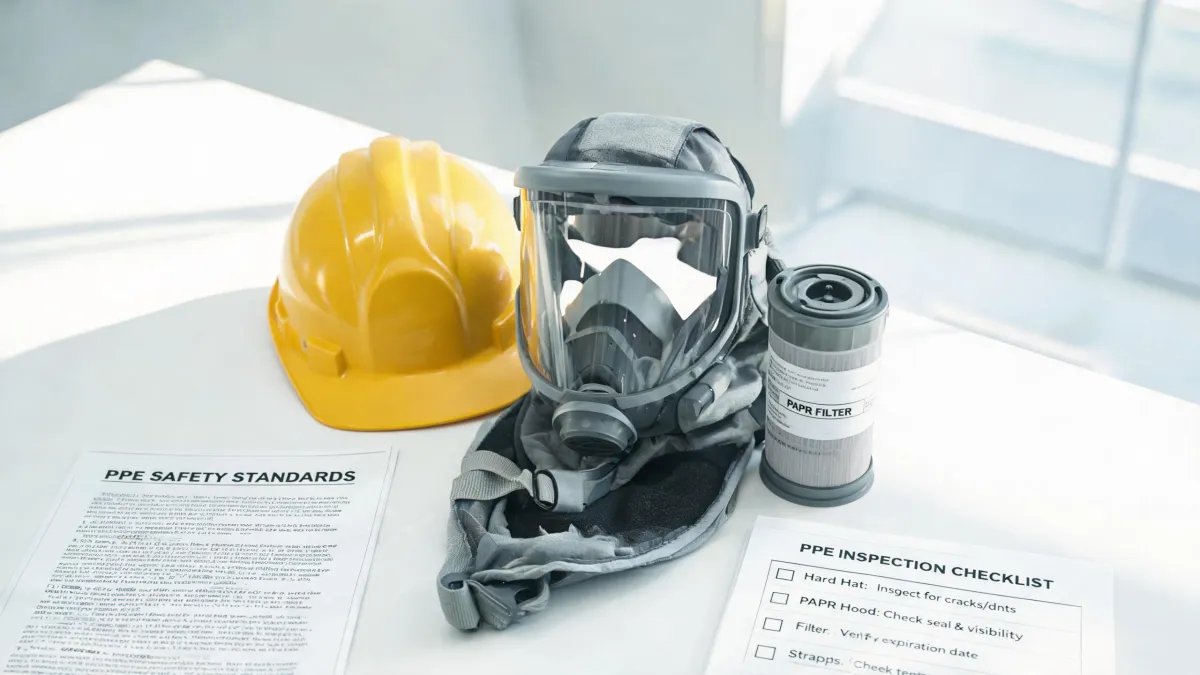
Bullard's PAPR systems are NIOSH-approved under 42 CFR Part 84, with cartridges for particulates, organic vapors, and combination hazards. Since Bullard also makes hard hats and face shields, you can build an integrated head-and-respiratory setup from one manufacturer—which simplifies fit, compatibility, and support.
The mistake I see most: buying PAPRs "to be safe" without the training, battery management, and cleaning protocol that goes with them. A PAPR is a system, not a single purchase. Plan the whole system before you write the PO.
What's the "invisible fence" in a PPE program?
That phrase confuses people the first time they hear it. It's not a pet containment system.
The invisible fence in workplace safety is everything you can't see: hazard assessments, training records, fit test documentation, inspection logs, replacement schedules. It's administrative. It's unglamorous. And it's the first thing to develop holes when an emergency hits.
In November 2023, a manufacturing client called at 3 PM on a Friday. Their compliance audit was Monday morning, and their respirator fit test records covered roughly 60% of the crew. The other 40% had been hired in the previous year, and nobody had scheduled their tests. That conversation was not fun.
That's an invisible fence failure. The equipment was fine. The paperwork wasn't. A $7,000 rush order and a weekend of scrambling could have been avoided by a 30-minute quarterly calendar review.
Here's something vendors won't tell you: audit season is when we make the most money. But you don't want to meet me for the first time because of an audit gap. Check your invisible fence during a quiet month, not the week before an inspection.
What does a "white picket fence" Bullard PPE program look like?
A colleague of mine uses that phrase—the white picket fence is the complete program. The one that runs smoothly enough that you stop having emergency conversations with people like me.
It looks like this:
- Head protection matched to each zone: hard hats where there's overhead hazard, First Base bump caps for low-clearance and bump-prone areas.
- Eye and face protection integrated with head protection, so nothing ends up in a pocket instead of on a face.
- Respiratory protection matched to actual air quality data, not what's on sale. Fit testing and training on a calendar, not in someone's head.
- Spare parts in inventory: replacement suspension, sweatbands, cartridges, batteries. The $400 part you don't have in stock becomes a $1,400 Friday-afternoon rush order.
Bullard covers the full spectrum—head, eye, face, respiratory—which is why their gear shows up on more and more compliance lists. But equipment is only half the fence. The system around it—records, training, inspection, replacing parts before they fail—is the other half.
Get both right, and you've built something that doesn't need me anymore. That's the white picket fence.