So You Found an Old Box of Respirators in Storage
There's that moment every safety manager knows: you're prepping for an arc flash training or a confined space job, and someone pulls out a box of respirators that's been sitting since 2021. Maybe even older. On the side, there's a faded NIOSH approval. The cartridge looks fine. No visible damage.
And you think: Can we still use these?
That's the surface question. The one most people stop at. But in my role coordinating respiratory protection for industrial clients across multiple states, I've learned that the expired respirator question is rarely the real problem. It's just the visible symptom of something deeper going wrong in how we manage PPE.
The Question Nobody Asks About 'Expired'
Let's get this out of the way: I'm not a regulatory attorney or a NIOSH lab technician, so I can't speak to the legal nuances of every jurisdiction or the specific chemical degradation of every cartridge material. What I can tell you, from a procurement and field-safety perspective, is what I've seen happen when expired gear gets used — and more importantly, ignored.
To be fair, the manufacturers aren't always clear about expiration reasoning. A 2019 study by the CDC found that many users assume 'expired' means 'completely useless,' when in reality, a properly stored elastomeric half-mask might still seal fine years after its manufacture date (Source: NIOSH, 2019). But a cartridge stored in a hot truck or humid locker? That's different. The charcoal can lose adsorption capacity. The filter media can degrade. You might still get a seal but not enough protection for an arc flash byproduct like hydrogen fluoride.
I still kick myself for not documenting the conditions of our storage room back in 2023. If I'd had temperature logs, I could've proven our stock was fine. Instead, we scrapped $4,000 worth of cartridges because nobody could say for sure they'd been kept below 100°F.
The Deeper Issue: 'Compatible' Doesn't Mean 'Optimal'
Here's where the real problem starts — and it's not about expiration dates. It's about what happens when you mix systems.
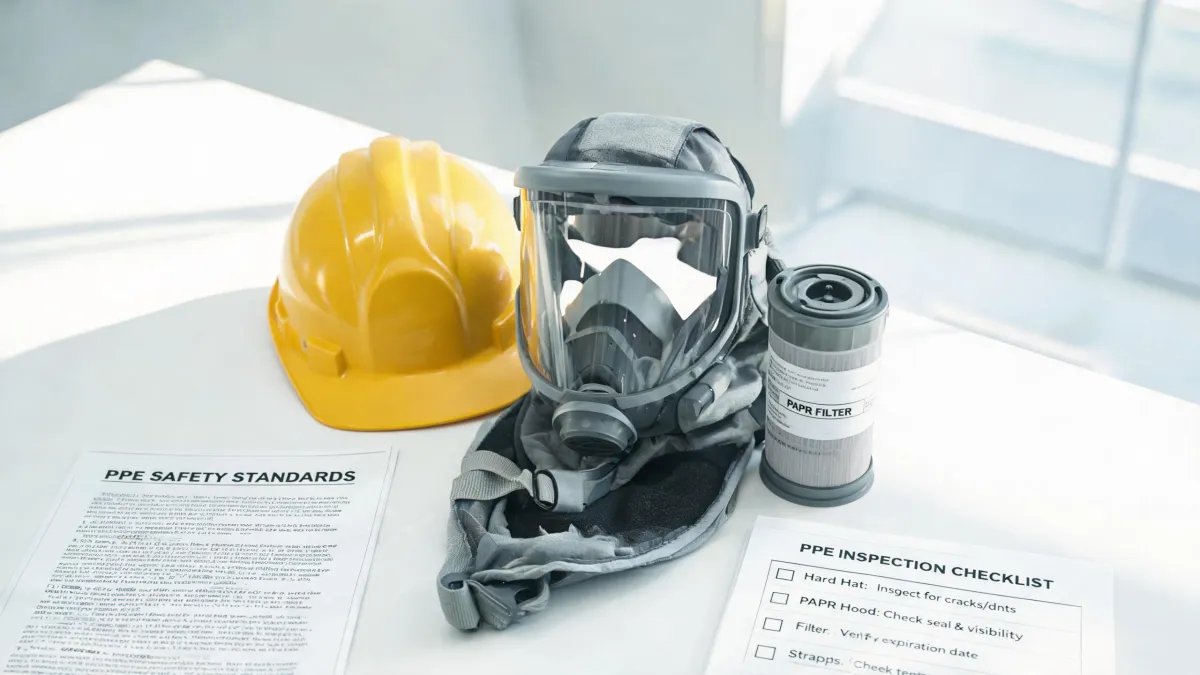
Say you've got a Bullard PAPR hood, NIOSH-approved, working fine. But someone on your team orders a different brand's cartridge because it's cheaper. Or you've got an older Bullard hard hat with a face shield bracket, and someone clips on a generic shield that sorta fits. It works physically — clicks in place, seems secure.
I get why people do this. Budgets are real. When I was running safety for a 40-person crew on a tight construction timeline, I made that call myself once. We needed 12 PAPR hoods for a paint job, and the cheapest option at the time was a mixed-brand setup. It seemed fine. Until it wasn't.
What I learned the hard way: NIOSH approval applies to the system, not just the individual components. A Bullard PAPR hood is tested and certified using Bullard components. The airflow rates, the seal geometries, the materials — they're designed to work together. Drop in a different cartridge or a different hood, and you've invalidated the certification. You might still get protection. But at that point you're hoping.
They warned me about this in a 2024 Bullard training session. I didn't listen. We lost a $50,000 contract review because the client's safety auditor caught the mismatched gear during a walkthrough. The auditor didn't flag it as a violation; they just noted 'inconsistency in the PPE system.' That note cost us the deal.
The Cost of Not Knowing What You Have
If I'm being honest, this gets into territory that's not just about compatibility. It's about system visibility.
Part of me thinks the real problem is that most companies don't have a PPE inventory that's actually current. You might know you ordered Bullard PAPR hoods two years ago. But are they still in service? Have they been reconditioned? Are the cartridges the right ones for the arc flash PPE you're wearing with them?
Another part of me — the part that's dealt with a lot of small clients — knows that even when you want to do the right thing, the suppliers don't always help. I've had clients call me frustrated because they tried to buy a single replacement hood for their Bullard PAPR, and the vendor told them there was a minimum order of 20 pieces. Or they wanted a custom configuration for a small crew, and nobody would quote them.
Small doesn't mean unimportant. When I was starting out in safety, the vendors who treated my $200 orders seriously are the ones I still use for $20,000 orders. The ones who shrugged off a small request? I don't call them anymore.
But the irony is: small buyers often need more help, not less. A large company has a safety department. A small construction crew has one foreman who's also ordering supplies, managing the schedule, and probably has a half-empty box of expired respirators because nobody told them what to look for.
What Actually Works (and What Doesn't)
So what's the solution? I've got three things that genuinely helped our clients — and one that's probably a waste of money.
System-level documentation
Instead of buying masks here and cartridges there, define your PPE systems. If you use Bullard for head protection, Bullard for respiratory, and Bullard for face shields — great. Document that and stick to it. If you mix brands, that's fine too, but make sure the components are certified together. The manufacturer's compatibility matrix isn't a sales tool; it's a safety specification.
Regular, no-nonsense audits
Not the kind where a consultant shows up and writes a report. I mean a physical check: open the storage bin, look at the date codes, feel the seals. I've had clients who do this monthly. They catch expired cartridges before they hit the field. They avoid the emergency scramble at 7 PM the night before a job.
Small orders: make it easy
For the love of safety, if you're a distributor, sell one hood. Charge a reasonable markup. Don't hide behind a 20-piece minimum when someone just needs to replace a single damaged unit. The repeat business you'll earn from being the 'guy who helped when we needed it' is worth more than the margin on a bulk order you might not get anyway.
What wastes money: 'universal' adapters
I'm skeptical of any adapter that claims to make Brand A's cartridge work with Brand B's mask. I've tested three different 'universal' solutions in the past two years for clients. Two didn't seal correctly. The third worked, but only with one specific combination that wasn't NIOSH-tested. I'm not comfortable recommending a workaround unless you've got documented fit testing and approval from both manufacturers.
The Bottom Line
The expired respirator is a symptom. The real question is: who in your organization owns the system? If it's split across procurement, maintenance, and a safety coordinator who only visits quarterly, you'll always have gaps.
Pick your PPE platform — Bullard, 3M, MSA — whatever works for your jobs. Commit to it for the life of the equipment. And please, if you're a small crew or a manager with a tiny budget, don't accept silence from your suppliers. If they won't sell you one hood, find someone who will.
That's the advice I wish someone had given me three years ago, before I wasted $800 on incompatible parts and learned the lesson the expensive way.