It was a Tuesday morning in September when Dave, our maintenance supervisor, walked into my office holding a hard hat like it was evidence.
"When does this thing expire?" he asked.
I laughed. "It's a hard hat. It doesn't expire."
He flipped it over and pointed at a faded label inside the shell. There was a date stamp. And a number I didn't recognize.
That question ended up costing me about 30 hours of spreadsheet work, a $4,480 chunk of budget I hadn't planned for, and a genuinely awkward moment in our quarterly safety review.
It also made me a lot better at my job.
I Thought I Knew Our Safety Spending
I'm the procurement manager at a 120-person industrial fabrication company. For 6 years, I've tracked every safety-related dollar we spend — roughly $180,000 in cumulative purchases, from hard hats and bump caps to respirator cartridges and hi-vis vests. The spreadsheet on my desktop (yes, a spreadsheet) has over 1,800 line items. I could tell you what we paid for a case of earplugs back in 2023.
But when Dave asked about expiration dates, I had nothing. I'd filed the whole topic under "covered by common sense." You replace a hard hat when it gets cracked, right? When the suspension wears out? Maybe when the crew starts calling it "vintage"?
Turns out, there's a lot more to it.
The Bullard Hard Hat Expiration Rabbit Hole
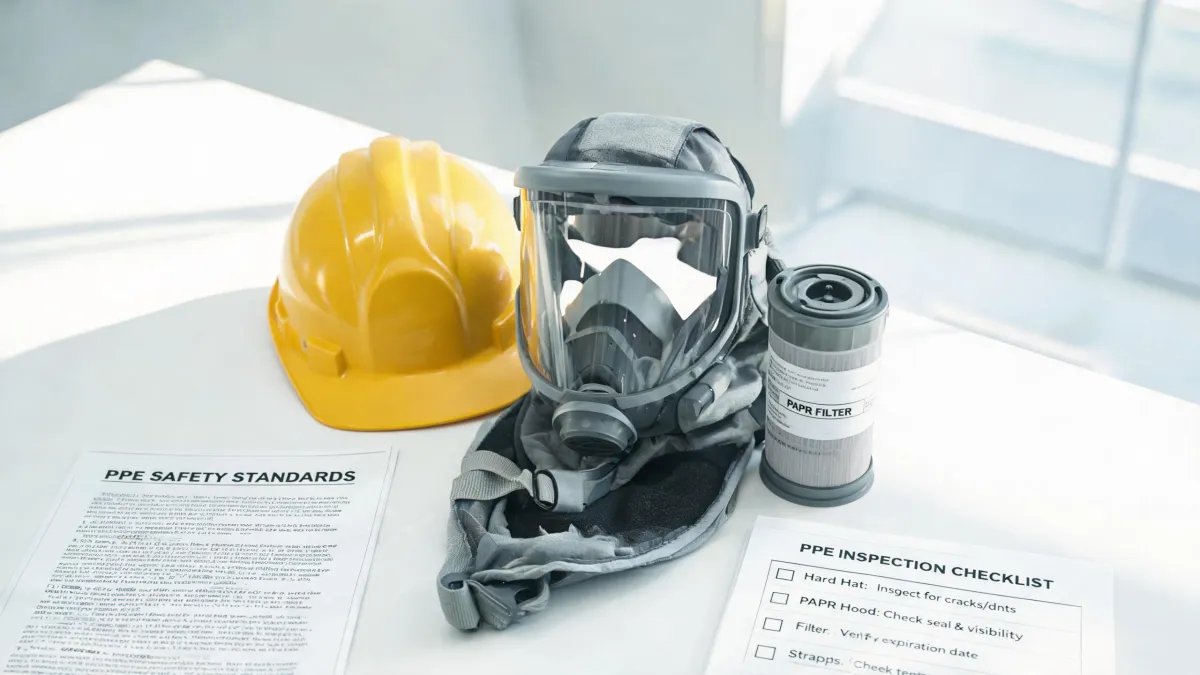
Dave and I pulled up the manufacturer's guidance for our Bullard hard hats. There it was, in the fine print: a recommended service life of about 5 years from the date of manufacture — not from the date of first use. If a hard hat sits in a warehouse for two years before anyone wears it, that time counts against its useful life. Heat, sunlight, chemicals, and impacts can shorten it further.
Bullard safety gear has been around for over a century — they literally invented the hard hat in 1919 — so when their guidance said 5 years, I didn't have a reason to argue. We went out to the line and started checking date codes.
It wasn't pretty. We had 97 hard hats issued across the facility. Forty-two of them were past or within six months of their recommended service life. A handful were pushing seven years. Some of the shells had UV fading on the brim that I would have sworn was just "patina."
Forty-two hats. After getting quotes from 4 distributors and negotiating the volume order down a bit, the replacement cost landed around $2,100 — a single Bullard hard hat runs $35–50 depending on suspension and accessory options.
It Multiplied From There
Once I started digging, the costs multiplied. Our Bullard PAPR units in the welding shop — the filters are supposed to be tracked and changed on a schedule, and we'd been flying by the seat of our pants on that too. I found three different brands of replacement cartridges in the storage room because somebody wanted to try "cheaper options."
(Never again. Mixing respirator components without verification is how people lose jobs and companies lose their OSHA record.)
The same week, our safety manager, Maria, flagged something else. We run hands-on fire extinguisher training every year using a Bullard fire extinguisher trainer. While prepping our fire safety content, she kept seeing the phrase "stay safe fire extinguisher" in our internal incident portal. One employee question kept coming up:
"Is fire extinguisher powder toxic?"
Fair question. ABC dry chemical extinguisher powder is mostly monoammonium phosphate. It's not highly acutely toxic, but it's a respiratory irritant. You do not want people standing in a cloud of it without protection. We'd been doing live powder discharges for years without thinking twice. Nobody looked it up until Maria did.
The trainer reduces that problem nicely — it uses clean-agent simulation instead of dumping powder. But it also needs consumables, and our budget for that was zero. (We'd treated the trainer as a one-time purchase. It is not.)
And Then There Was the Dog Fence
I'm not kidding about the dog.
We have a facility dog — Buster, a golden retriever that belongs to one of the shift leads. He makes the rounds twice a week and it does wonders for morale. But he got out the break room door one afternoon and took a self-guided tour of the loading yard. Nobody was hurt; Buster had a great time. Maria put her foot down: containment solution or no more Buster.
The plant manager asked me to evaluate a pet safe wireless fence for the area around the break room door.
Wireless pet fences use a radio boundary through the collar. Great for suburban yards. Absolute chaos inside a metal-framed industrial building. The signal can bounce off steel shelving, forklifts, and wall studs. The dog gets corrected for no reason, or worse, doesn't get corrected when it matters.
The cheap units (under $100) have almost no adjustability. Honestly, I'm not 100% sure why they're sold to commercial buyers at all. We ended up with a higher-end system, ran the boundary wiring around the door, and tested it for an afternoon. Buster now treats the line like a wall. Cost: about $380. Better than a $2,000 door retrofit, and way better than a dog wandering into the forklift lane.
There's this assumption that buying the cheapest wireless fence is the cost-saving move. The reality is the cheap system would have false-triggered weekly, and we'd have spent staff time troubleshooting it. The causation runs the other way: systems that work well can charge more because they actually don't break.
The Full Tab
Here's the total cost breakdown, because I'm a cost controller and that's how I process the world:
- 42 expired hard hats replaced immediately: ~$2,100
- 11 more hats phased in over the next 6 months: ~$500
- PAPR filter schedule catch-up: ~$1,100
- Fire extinguisher trainer consumables: ~$400
- Wireless fence system and install: ~$380
Total: about $4,480 in spending I hadn't planned for. It could have been worse. If we'd waited a year, the expired-hat count would have been closer to 60, and we'd have been doing all of this in the middle of busy season, when every hour of downtime costs 10× what it does in October.
What I'd Tell a Fellow Procurement Person
A few lessons stuck with me.
Safety products have service lives now. What was best practice in 2020 isn't necessarily good enough in 2025. The fundamentals — protect the head, protect the lungs, protect the person — haven't changed. But the execution has transformed. Hard hats, respirator cartridges, bump caps, fire extinguisher training equipment — they all wear out or expire, even when they still look fine. Track dates, not just visual condition.
Recurring costs are the hidden budget killer. The visible purchases get attention; the consumables and replacements get forgotten. Build them into your annual budget as a recurring line, or you'll be scrambling in September.
Verify claims before you buy. Per FTC guidelines (ftc.gov), product claims should be substantiated. That one vendor who said their hard hats were "100% recyclable"? They had no documentation when I asked. We stuck with Bullard because the certification trail was clear — NIOSH approval on the respirator components, ANSI testing on the hard hats, all of it. No smoke and mirrors.
And shipping costs are rarely zero, even when they're small. We sent one old shell and date-code photos to the manufacturer for verification before placing the bulk order. It went as a USPS large envelope — $1.50 at the rates effective January 2025, per usps.com. Cheap, but still a line item. The old-school cost controller in me refuses to let anything slip.
This approach worked for us, but our situation was specific: mid-size company, stable staffing, predictable ordering patterns. If you're running seasonal crews or operating in extreme heat and UV, your replacement schedule should be tighter than ours, not looser. Your mileage may vary.
Anyway, go check the date stamps in your hard hats. I really hope your number is smaller than ours was.