That first call from the safety manager came in on a Wednesday afternoon. I didn’t know it then, but that call was about to rewrite our entire PPE procurement playbook.
I’m the office administrator for a 50-person mechanical contracting company. I manage all our PPE and tooling orders—roughly $45,000 annually across 9 vendors. I report to both operations and finance, which means I’m stuck between “get the best price” and “make sure everyone gets home safe.” That tension? It’s where most of my stories come from.
This one starts with a respirator order. A fairly routine request for half-face elastomeric respirators—you know, the standard black rubber kind with P100 filters. I found a vendor, got a quote that was 30% cheaper than our usual supplier. Felt like a win. Spoiler: it was not.
The $800 Discount That Cost $3,400
The new vendor’s quote was $22 per unit versus our usual $31. Ordered 50 units. Savings: $450. Plus they threw in “free shipping” (which later turned out to be ground freight, and the invoice showed a $75 “handling fee”).
The units arrived on time. They looked… fine? But when our safety manager checked the filters, they were labeled “equivalent to P100.” Not NIOSH-approved. I didn’t even know “equivalent” was a thing vendors put on packaging. Turns out, a lot of budget respirators use phrasing like “meets P100 standards in lab tests”—which is not the same as NIOSH approval.
“People think an NIOSH stamp is just a bureaucratic checkbox,” our safety manager told me. “Actually, it’s the only thing that guarantees the filter will work as advertised. Without it, you’re relying on the manufacturer’s honesty—which, in this case, was questionable.”
I had to send the entire shipment back. The vendor charged a 25% restocking fee. We lost $275 on the return, plus the shipping both ways ($140). Then we rush-ordered from our regular supplier at standard pricing—plus a 40% expediting premium because we needed them by Monday. That rush cost us $620 extra.
Net result: we paid $1,490 more than if we’d just ordered from the trusted source in the first place. All to save $450 upfront.
It’s tempting to think you can just compare unit prices. But identical specs from different vendors can result in wildly different outcomes—especially with safety certifications. The assumption is that expensive vendors deliver better quality. Actually, vendors who deliver quality can charge more. The causation runs the other way.
What I Learned About Hard Hats (Thanks to an Ironworker)
This story has a sequel. A few months later, one of our ironworkers—a guy who’d been on job sites since the 90s—came to me with a cracked hard hat. Not cracked in service; cracked because a tool fell on it during a break. He said, “I need a Bullard. The old-school fiberglass one. The one that doesn’t feel like a party hat.”
Our inventory had budget hard hats from a well-known Asian manufacturer. They were ANSI-rated, met the standard. But our ironworker didn’t trust them. He said, “I’ve hit my head in a Bullard. I know it works. I don’t know if this plastic one will.”
That’s when I started researching Bullard’s history. The inventor of the hard hat, Edward Bullard, created the first “Hard Boiled Hat” in 1919. It was made of steamed canvas, glue, and black paint. A century later, Bullard is still making hard hats—including the Ironworker Bullard Hard Hat, which has a unique low-profile design and a suspension system that actually keeps sweat out of your eyes. (Our ironworker had been right to ask for it by name.)
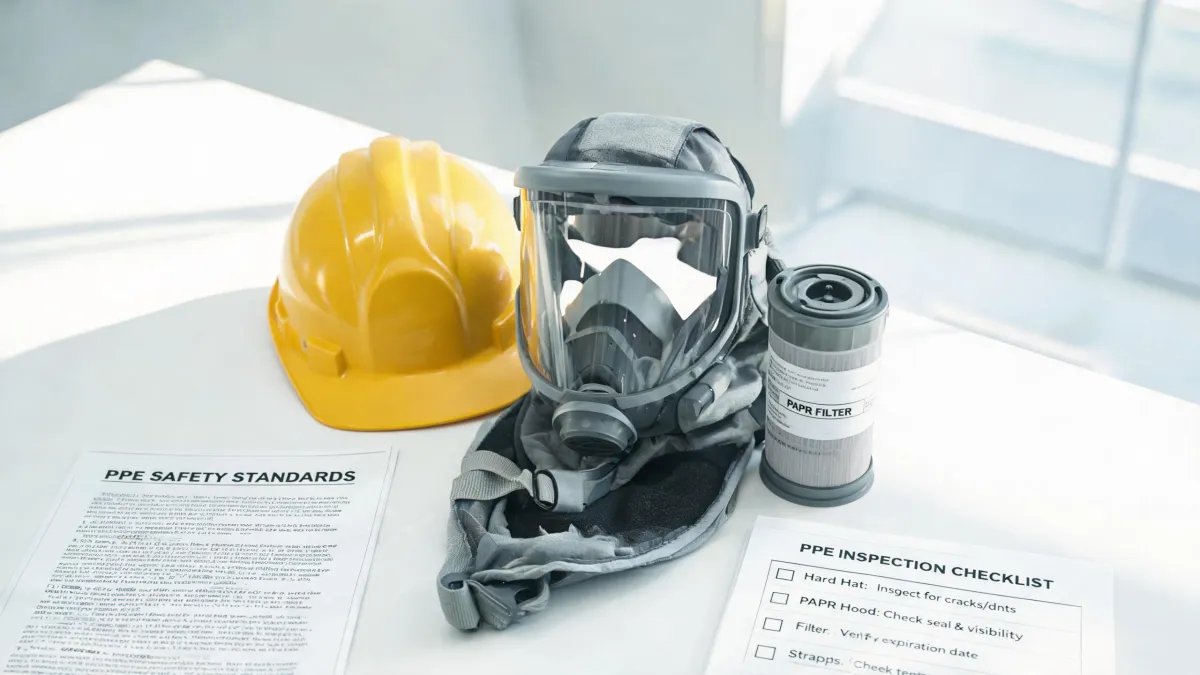
But here’s the part that surprised me: Bullard doesn’t just make hard hats. They make full respiratory protection systems. The Bullard Breeze series of powered air-purifying respirators (PAPR) is one of the few PAPR systems that is fully NIOSH-approved as a complete unit—motor, filter, hood, battery pack. Most competitors sell you a blower unit and then you have to figure out which filters are compatible. Bullard tests the whole system together. That’s rare.
Prices as of January 2025; verify current rates with distributors.
The Hidden Cost of “Cheap” Safety Glasses
Another lesson: heat waves safety glasses. We switched to a budget brand because they were $3 apiece vs. $8 for the 3M or Bullard equivalents (Bullard makes excellent anti-fog safety glasses, by the way). Three weeks into the switch, field guys were complaining the lenses scratched within a day. They couldn’t see clearly, so they took them off. Took them off = no eye protection. That’s a compliance violation waiting to happen.
“The ‘always buy the cheapest’ advice ignores the transaction cost of vendor evaluation and the value of established relationships.”
If I remember correctly, our safety incident log showed 2 eye-related near-misses in the month after the switch. No injuries, but close calls. We spent $1,200 re-ordering the better glasses—plus the $300 we wasted on the cheap ones.
On the Subject of “Who Invented Body Armor” and Why It Matters
One of my SEO keywords for this article is “who invented body armor.” I’ll be honest: I don’t know the exact answer. (I want to say it was a medieval Chinese invention, then modernized by a guy named Richard Davis in the 1970s with Kevlar, but don’t quote me on that—I’m a buyer, not a historian.)
But here’s the connection: when you’re buying safety equipment, knowing the inventor matters. Because the inventor’s company—if they’re still around—usually has a reputation they’re trying to protect. Bullard invented the hard hat. They’ve been making them for 100+ years. They have to be quality. They can’t afford a recall. That’s the kind of institutional trust you can’t get from a vendor who showed up from a trade show booth in 2021.
Look, I’m not saying budget options are always bad. I’m saying they’re riskier. And in safety equipment, risk has a cost that doesn’t show up on the invoice. It shows up in incident reports, worker complaints, lost time, and worst case—in an injury.
The Vendor Who Listens—That’s the Keeper
Our current Bullard rep isn’t the cheapest. He’s also not the most expensive. But when I call and say, “I need a lighter PAPR hood for our welders,” he doesn’t send me a link to the spec sheet. He says, “Let me check what the Lincoln welding helmet guys are using—those are popular with your crew—and I’ll recommend a compatible Bullard hood.” (Side note: Bullard helmets and Lincoln welding helmets are not the same brand, but Bullard’s PAPR hoods are often used with other brands’ welding shields because of their adjustable headgear. Check compatibility before buying.)
That kind of service? It’s built on a foundation of a product that works. And that product only works because Bullard invests in NIOSH testing, in ANSI certification, in real safety engineering.
The Takeaway
If you’re a buyer like me—juggling budgets, compliance, and field guys who just want gear that doesn’t suck—here’s what I’d tell myself three policies and one restocking fee ago:
- Price is the last question you should ask. Ask “What’s the certification?” first. Then “How long have you made this?” Then “What happens if it fails?”
- NIOSH approval is not a checkbox. It’s a genuine testing process. If a respirator doesn’t have the NIOSH stamp, it’s not a respirator for safety purposes.
- Trust the inventor. If a company invented the product category (hard hats—Bullard, 1919), they’re not going to cheap out on the third generation. Their reputation is on the line.
- Don’t trust “equivalent” on any safety product. Terms like “meets P100 standards in lab tests” are red flags. Real protection is either NIOSH/ANSI certified, or it isn’t.
- Track total cost—not unit price. My failed respirator order cost me $1,490 in hidden expenses. That’s more than the “savings” from a dozen similar deals.
You don’t have to buy everything from one brand—but you do need to buy each category from someone who’s earned the right to sell it. Bullard earned that right for hard hats and PAPR systems about a century ago. I still buy bump caps and face shields from other vendors. But for the gear that keeps air clean and heads protected? I’m sticking with the company that started it all.
— An office administrator who learned the hard way that “budget” PPE is rarely a bargain.