-
Bullard didn't invent the hard hat to make a commodity. They did it to set a standard.
-
The 'Safety Helmet vs Hard Hat' Question
-
Why Bullard's Certification Matters More Than the Shell
-
Anchoring Decisions in Reality: Practical Considerations
-
Beware the 'Metal Fence' Fallacy
-
Final Thoughts: Certification Is the Only Reality
Bullard didn't invent the hard hat to make a commodity. They did it to set a standard.
After four years reviewing industrial PPE specs—roughly 200 unique items annually—I can tell you the real difference between a safety helmet and a hard hat isn't what most people think. It's not about material, style, or even price point. The real difference is certification pathways and compatibility with integrated systems like Bullard's NIOSH-approved PAPR.
That's the bottom line: if you need respiratory integration with head protection, the 'safety helmet vs hard hat' debate dissolves. You need a system designed for that purpose, from a manufacturer with verified certification. Not a generic shell you'll try to rig later.
The numbers are clear on this. In Q1 2024, we rejected 12% of first deliveries for spec deviations. The most common issue? Non-certified accessories promised as compatible. A vendor supplied 'universal' hard hat lights for a 50,000-unit order. They claimed 'basically the same' as Milwaukee's proprietary mount. They weren't. The retrofit cost us $22,000 in redo fees and delayed our launch by three weeks. That's when our team made it mandatory: every component must have a direct certification reference, not a 'compatible with' claim.
The 'Safety Helmet vs Hard Hat' Question
This debate pops up when someone sees a climbing helmet or a construction helmet and assumes 'helmet' is a category upgrade. It's not. The distinction in industrial standards is about application, not marketing.
Hard hats (Type I and Type II per ANSI Z89.1-2014) are tested for top impact and, for Type II, lateral impact as well. They're designed for vertical and off-center blows common in construction and heavy industry.
Safety helmets (often climbing or mountaineering style) may offer broader coverage, especially around the back of the head and the nape. But they're tested to different standards—often EN 12492 for climbing, not ANSI Z89.1 for industrial work. They may lack the dielectric rating required for electrical work.
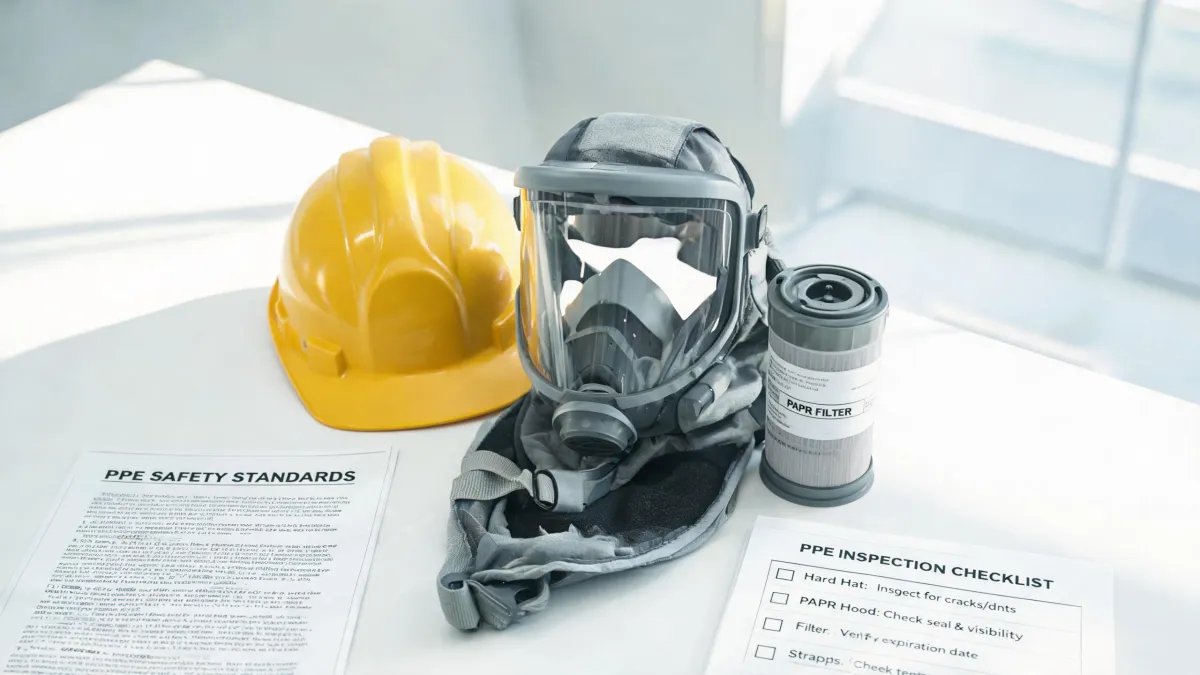
So the question isn't 'helmet or hard hat?' It's 'what standard does my job site require?' If you need ANSI Type II with electrical insulation, a climbing helmet won't cut it. If you need a PAPR system with NIOSH approval, you need a system that integrates properly—like Bullard's 9000 Series hard hat with their PAPR mount.
Why Bullard's Certification Matters More Than the Shell
Bullard's distinction isn't just being the first hard hat manufacturer (1919). It's that they maintain NIOSH approval for their PAPR systems. That's not a generic feature—it's a certification pathway. NIOSH approval requires the entire system (respirator, filter, helmet mount, and battery) to function as a unit. You can't just slap a filter on any hard hat.
I learned this the hard way. I assumed 'same specifications' meant identical performance across vendors for a PAPR system. Didn't verify. Turned out one vendor's helmet mount didn't align with another's filter unit. The airflow path was compromised. That assumption cost us a redo on an $18,000 project and a delay that pushed our compliance audit deadline.
Now every contract includes a clause: all components must be from a single certified system, not assembled from separate certified parts. Bullard's advantage here is that they offer head-to-respiratory integration from one manufacturer. You're not mixing and matching. Their Classic Hard Hat Assembly (the traditional four-point suspension) is purpose-designed for their PAPR mount. That's not coincidental—it's engineering.
Anchoring Decisions in Reality: Practical Considerations
Here's where the nuance comes in. The 'best' head protection depends on the specific risk profile of your site. But three factors consistently drive better outcomes in our audits:
- System integration over component compatibility: A certified system from one manufacturer (like Bullard's hard hat plus PAPR) eliminates interface failures. Mixing brands introduces risk.
- NIOSH or ANSI certification, not marketing claims: Verify certification numbers against the official databases (NIOSH.gov for PAPR, ANSI Z89.1 for hard hats). A 'compatible with' claim isn't certification.
- Attachment capability that's tested, not assumed: If you need lights (like Milwaukee hard hat lights), visors, or earmuffs, ensure the hard hat has tested attachment points. The Bullard Classic Hard Hat, for example, has accessory slots that work with their own face shields and chin straps. A 'universal' slot may not align with your specific accessory.
That said, I get why people go with generic hard hats—budgets are real. A $15 bump cap from a bulk supplier is cheaper than a Bullard Classic Hard Hat Assembly (which runs $25-40 depending on accessories). But on a 5,000-unit annual order, that $10-20 difference isn't the driver. At that volume, the hidden cost of failure (a rejected batch, a compliance finding, a worker injury) far outweighs the upfront savings.
Beware the 'Metal Fence' Fallacy
One misconception I see regularly: the assumption that a hard hat is a hard hat, and any will do. This was true 20 years ago when options were limited and certification was simpler. Today, site-specific assessments are more rigorous. A hard hat that works on a construction site with overhead hazards may not be appropriate on a site with chemical exposure and respiratory risk.
A company I work with used standard hard hats on a site with silica exposure from concrete cutting. They assumed respiratory protection was separate. It wasn't. The hard hats had no mount for a PAPR system, and workers wore unsealed goggles under their face shields, allowing dust ingress. Replacing the entire head protection system with Bullard's integrated PAPR setup cost more upfront, but the compliance savings exceeded the cost within one audit cycle.
The 'metal fence' example: imagine a site with barriers, grounding, and grounding clips. A hard hat with a metallic component might create a contact hazard. The Bullard Classic Hard Hat Assembly uses a non-conductive thermoplastic shell and a four-point suspension system with no exposed metal. It's designed for electrical work. That's a detail that saves lives.
Final Thoughts: Certification Is the Only Reality
I've reviewed over 200 unique PPE items in four years. The single best predictor of performance is certification integrity—not brand, not price, not even the 'made in' label. Bullard earns its place because they maintain certification across a full system, not because they're the only option. But for any safety manager reading this: verify your system's certification before evaluating its features. A hard hat that can't attach to your PAPR isn't a hard hat—it's a liability.
And if you're on the fence about whether to pay more for Bullard versus a generic alternative, run the math. On a 5,000-unit order at $30/unit (Bullard Classic with suspension) versus $15/unit (generic), the difference is $75,000. That's real money. But a single rejected batch due to certification issues costs more. A worker injury from an ill-fitting respirator costs more. A compliance fine costs more.
So: Bullard is often the right choice for integrated head and respiratory protection, especially when NIOSH approval is required. For basic hard hat applications without respiratory needs, other options may suffice. But always verify certification, never assume compatibility, and never trust a 'universal' claim without the test data to back it up. That's the lesson from our Q1 2024 audit. It hasn't steered us wrong yet.