-
There's No 'Best' Bullard Product — Only the Right One for Your Specific Situation
- Scenario A: The Low-Risk Indoor Environment — Wood Fence Staining, Assembly Lines, Warehousing
- Scenario B: The High-Risk Environment — Construction, Demolition, Heavy Manufacturing
- Scenario C: The Specialized or Emergency Environment — Fire Extinguisher Training, Hazmat, Confined Space
-
How to Determine Which Scenario You're In
There's No 'Best' Bullard Product — Only the Right One for Your Specific Situation
If you're searching for a single answer on what Bullard PPE to buy, you're probably not going to find it here. Honestly? You shouldn't. The right choice depends entirely on what your crew is doing, where they're doing it, and how much risk you're dealing with. I've spent the last six years coordinating safety equipment orders for industrial and construction clients, and I've processed over 200 rush orders for PPE ranging from simple bump caps to full PAPR systems. What I've learned is that the conventional wisdom — "always buy the highest protection level available" — is often wrong. Let me show you what actually works, scenario by scenario.
Everything I'd read about PPE selection said you should always err on the side of over-protection. In practice, I found that's not always the best call. Over-protecting can actually create new risks — like workers refusing to wear a heavy hard hat in a low-risk environment, or failing to properly maintain a complex PAPR system because it's overkill for their actual exposure. The goal is the right protection, not the maximum protection.
“I'd rather spend 10 minutes explaining options than deal with mismatched expectations later. An informed customer asks better questions and makes faster decisions.”
Here are the three most common scenarios I encounter, and what I've found actually works for each.
Scenario A: The Low-Risk Indoor Environment — Wood Fence Staining, Assembly Lines, Warehousing
If your team is working indoors, in a controlled environment where there's no risk of falling objects from above, a full Type I hard hat is often overkill. I've seen crews on wood fence staining lines refuse to wear hard hats because they're heavy, hot, and uncomfortable for 8-hour shifts. That's a compliance failure waiting to happen.
What I recommend: Bullard Bump Caps
Bullard bump caps are designed exactly for this scenario. They're lightweight, low-profile, and protect against bumps and scrapes from stationary objects — like walking into a low pipe or hitting your head on a shelving unit. They're not designed to protect against falling objects, which is why they're not ANSI Type I rated. But if the hazard is bumping into things rather than things falling on you, a bump cap is the right tool.
I had a client in early 2024 who was about to order 50 standard hard hats for a warehouse crew. After walking their floor, I realized their real hazard was low-hanging conveyor belts and tight aisle shelving — not overhead drops. We swapped the order to Bullard bump caps, saved them about $15 per unit, and their compliance rate went from 40% to 95% in two weeks. The workers actually wore them because they were comfortable.
Remember the USPS Business Mail 101 specs? They define letter dimensions down to fractions of an inch. That's the level of specificity you need when matching a hazard to a protective device. A bump cap for bump hazards is like a standard envelope for a letter — it's exactly what's needed.
Scenario B: The High-Risk Environment — Construction, Demolition, Heavy Manufacturing
This is the classic scenario everyone thinks of. If your workers are on a construction site, in a demolition zone, or anywhere with overhead activity (cranes, scaffolding, tools being carried above), you need a Type I or Type II hard hat. No exceptions. I've seen the aftermath of a dropped wrench hitting a worker's head. The hard hat saved his life — but only because it was the right type and in good condition.
What I recommend: Bullard Full-Brim or Cap-Style Hard Hats
Bullard invented the hard hat in 1919. They know what they're doing. For general construction, a standard Type I cap-style hard hat (like the Bullard 3000 series) is sufficient for top-impact protection. For electrical work or confined spaces, you might need the Type II with lateral impact protection.
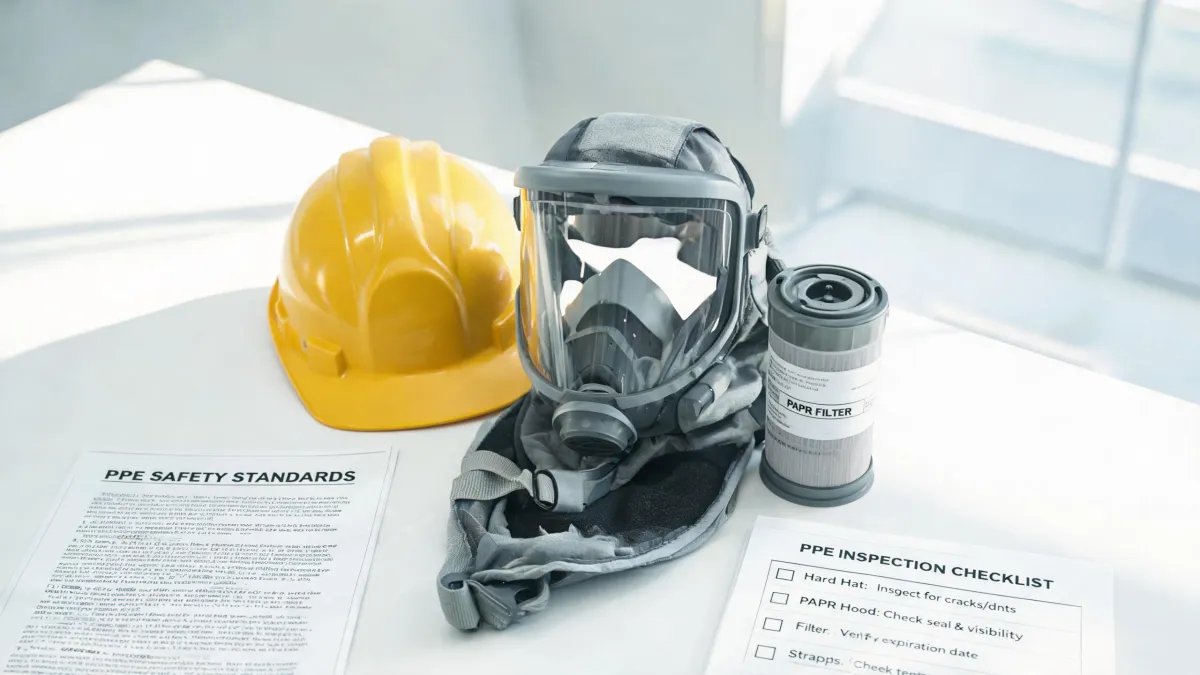
But here's where most people get it wrong: they buy a high-end hard hat and completely ignore respiratory protection. If your crew is cutting concrete, sanding lead paint, or working in a dusty environment, a hard hat alone isn't enough. You need respiratory protection that integrates with the head protection. That's where the Bullard EVA PAPR system comes in.
When a Hard Hat Isn't Enough: Adding a PAPR System
The Bullard EVA PAPR (NIOSH Approved) is designed to pair with their hard hats and visors. It's a powered air-purifying respirator that provides a continuous flow of filtered air. For workers in environments with airborne particulates — like wood staining, welding (though you'd need a Miller welding helmet for the optical protection), or chemical handling — a PAPR system dramatically improves comfort and safety compared to a standard N95 or half-face respirator.
Here's the kicker: a standard half-face respirator with a hard hat often creates a seal nightmare. The straps interfere, the hard hat shifts, and the worker ends up with a poor fit. The Bullard EVA integrates directly with their hard hat and face shield, creating a single, sealed system. It's more expensive upfront (a PAPR system runs $800-1500 compared to $20-50 for a hard hat), but the reduction in ergonomic issues and improved respiratory protection makes it worth it for the right application.
I processed a rush order in March 2024 for a client whose crew was doing concrete restoration in a parking garage. They had 36 hours before the project started and realized their standard half-face masks weren't compatible with their new Bullard hard hats. We expedited the EVA PAPR systems — paid about $200 extra in rush fees on top of the $1,200 base cost — and delivered them in 24 hours. The client's alternative was using inadequate respiratory protection and risking an OSHA citation. That's the kind of scenario where you don't cut corners.
Scenario C: The Specialized or Emergency Environment — Fire Extinguisher Training, Hazmat, Confined Space
This is the scenario most people don't think about. If your workers are doing fire extinguisher training, hazmat cleanup, or confined space entry, the PPE needs are completely different. A standard hard hat and N95 mask won't cut it.
What I recommend: Full Ensemble, Including Bullard PAPR with Appropriate Cartridges
For fire extinguisher training (can fire extinguisher scenarios), the primary hazard is the dry chemical discharge. Those particles are fine and will get everywhere. A Bullard EVA PAPR with a P100 filter will protect the trainee's airway while allowing them to communicate. Add a Bullard face shield to protect the eyes and face from the chemical cloud, and you have a training setup that actually works. I've seen trainers skip this and end up with trainees coughing through the entire drill.
For confined space entry, the Bullard hard hat with a chin strap (so it doesn't fall off when working in awkward positions) paired with a PAPR is the standard. But you need to verify the specific cartridge is rated for the contaminants present. The Bullard EVA uses standard NIOSH-approved cartridges, so you can swap based on the hazard. That's why having a modular system matters.
Per OSHA standards (29 CFR 1910.134), respiratory protection must be selected based on the specific hazard. A PAPR is only effective if the cartridge matches the contaminant. The Bullard system is NIOSH approved for multiple cartridge types, but it's on the safety manager to evaluate the specific environment. The NIOSH approval is your anchor. It's not a marketing claim; it's a federal certification.
How to Determine Which Scenario You're In
Here's a simple triage framework I use when helping clients:
- What's the overhead risk? If there's any risk of falling objects, you need an ANSI Type I or Type II hard hat. If the risk is only bumps and scrapes, a bump cap may suffice.
- What's the respiratory hazard? If there's dust, fumes, or chemicals in the air, you need respiratory protection. If a standard N95 doesn't fit well under the hard hat, consider a PAPR.
- Is the work specialized? Fire training, hazmat, and confined space work require multi-hazard protection. Don't try to use a single piece of PPE for multiple hazards — get a system that integrates everything.
- What's the compliance reality? The most protective system is useless if workers won't wear it. A Bullard bump cap worn consistently is better than a hard hat left in the locker.
I knew I should always recommend the highest protection level, but thought 'what are the odds a worker will actually refuse to wear a hard hat?' Well, the odds caught up with me when I audited a warehouse and found 60% of workers had their hard hats hanging on hooks — not on their heads. That was the one time it mattered. Now, I always ask about wearability, not just protection specs.
The choice between a Bullard bump cap, hard hat, and PAPR system isn't about picking the "best" product. It's about matching the product to the hazard, the environment, and the human being wearing it. Get that right, and you'll have better compliance, lower costs, and safer workers.