-
Hard Hats Aren't One Product Category
-
Cap Style vs. Full Brim: The Cosmetic Choice That Actually Isn't
-
The Brand Conversation: Milwaukee Hard Hats and Familiarity
-
Bullard PAPR Hoods: When the System Is the Product
-
Fire Extinguishers Taught Me the Same Lesson in a Different Color
-
What Did This Cost Us?
-
What I Do Differently Now
I'm the office administrator for a 220-person manufacturing company. Since 2020, I've handled all of our PPE and safety supply purchasing—roughly $45,000 a year across six or seven vendors. I report to operations and finance, which means I get pulled in two directions: operations wants gear that doesn't slow anything down, and finance wants numbers that don't look embarrassing. I'm the person in the middle.
When I started this job, I thought hard hats were the easiest line item on my purchase orders. Pick a color, confirm the ANSI label, done. Five years and a few expensive lessons later, I know that label is just the starting point.
If you're searching for terms like Bullard safety helmet, Milwaukee hard hat, or trying to decide whether a full brim hard hat is worth the extra money, this article is for you. It's not written by a safety engineer. It's written by someone who signs the paperwork and learned the hard way that safety equipment is never as simple as it looks.
Hard Hats Aren't One Product Category
The first trap is thinking that all hard hats are basically the same. They're not. In the United States, the relevant standard is ANSI/ISEA Z89.1, and it splits head protection into two types based on impact testing.
- Type I protects against blows to the top of the head. That's the classic falling-object scenario.
- Type II protects against blows to the top and the sides. If your crew works around low beams, swinging loads, machine arms, or anything that can strike the head at an angle, Type II is where the conversation starts.
Then there's the electrical class, which confuses more buyers than any other letter in the alphabet.
- Class C stands for conductive. No electrical protection at all.
- Class G stands for general. Tested to withstand 2,200 volts.
- Class E stands for electrical. Tested to withstand up to 20,000 volts.
I've met buyers who assume Class C means commercial and Class E means economical. If you're not a safety specialist, that's an easy mistake to make. But it's completely backward. I made that mistake in a small way early on, and it cost us money. Other companies have made it in a much bigger way and it's cost them far more than that.
Cap Style vs. Full Brim: The Cosmetic Choice That Actually Isn't
Here's another thing that looks like style but is really function: the brim.
A cap-style hard hat has a front brim, like a baseball cap. A full brim hard hat has a rim that goes all the way around the shell. At first glance, it seems like a matter of taste. But the choice affects how the hat performs in your specific environment.
Full brim hats give outdoor workers shade on the neck and ears. They keep rain from running down the back of a collar. On a hot, sunny job site, that shade is a real reason people actually wear the hat instead of leaving it on the truck seat. The brim also helps shed water and falling dust away from the neck and face.
Cap style hats, on the other hand, are often lighter and lower profile. They tend to work better in tight overhead spaces and under welding hoods. If your crew is mostly indoors in controlled environments, a cap style might be the smarter choice.
The point is not that one is better. The point is that choosing between them should be driven by the work your people actually do. When I stopped treating brim style as a cosmetic option and started asking where the crew works, our replacement rate dropped noticeably.
The Brand Conversation: Milwaukee Hard Hats and Familiarity
Let's talk about the phrase Milwaukee hard hat for a second, because I see it a lot in internal requests.
A few years ago, one of our superintendents asked me to order Milwaukee hard hats for his crew. His reasoning was simple: the guys trust Milwaukee tools, they like the brand, and they'll actually wear a hat that feels familiar. I understood that. Brand trust is real, and it's not nothing.
The Milwaukee hard hats we tested were fine. They met the standard, they were comfortable, and I don't have anything bad to say about them. But when we started adding accessories—face shields, hearing protection mounts, and other components—we ran into a systems problem. We had standardized our accessory ecosystem around Bullard helmets at other sites, and the Milwaukee hats didn't integrate cleanly with that existing setup.
We ended up with two different helmet systems, two spare parts inventories, and a supervisor who had to explain why one site used different brackets than another. It wasn't a safety failure. It was an efficiency failure, and it cost us time and money.
Here's the lesson I took away: a hard hat isn't a drill. When you buy a drill, brand loyalty matters because you're buying into a battery platform. When you buy head protection, brand loyalty should be the last consideration, not the first. The first considerations are the hazards, the accessories, and the system around the hat.
And if you're looking at Bullard specifically, their history matters more than people think. Bullard invented the industrial hard hat back in 1919. That doesn't automatically mean every product they make is the right one for you, but it does mean head protection isn't a side venture for them. It's the foundation of the company.
Bullard PAPR Hoods: When the System Is the Product
The same logic gets much more serious when you move from head protection to respiratory protection.
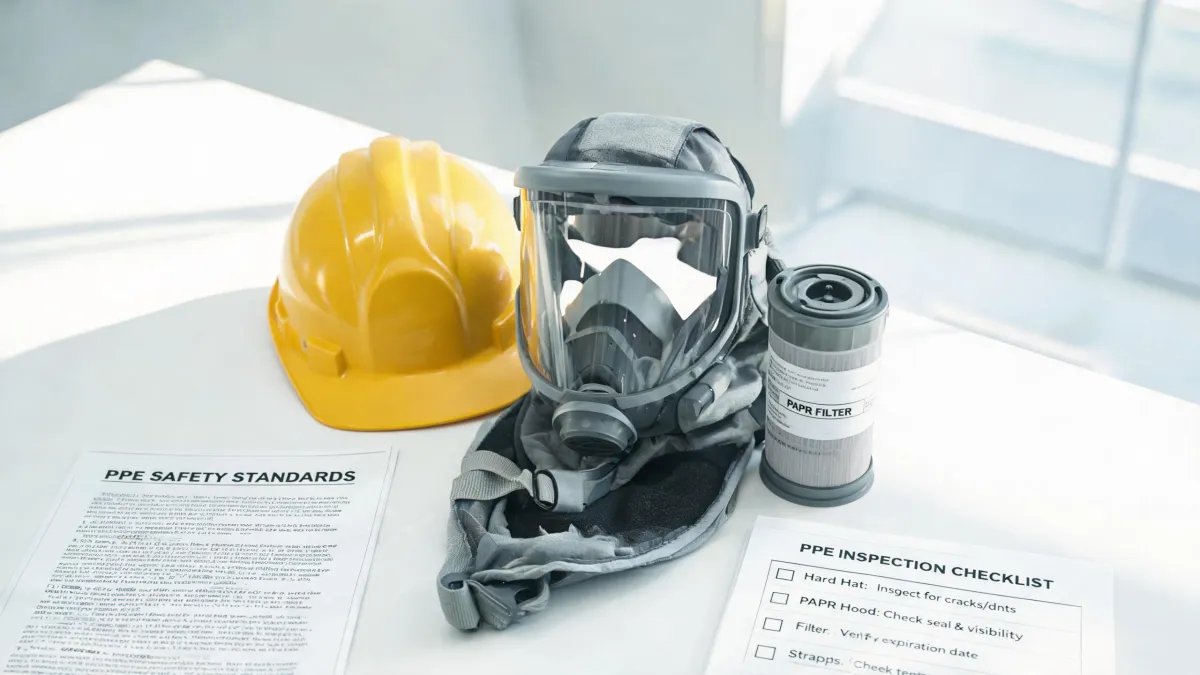
Our maintenance crew does sanding, paint prep, and some welding. For certain jobs, a standard hard hat isn't enough—they need a powered air-purifying respirator, or PAPR. A blower pulls air through filters and delivers it to a headtop, which is often a loose-fitting hood. It looks simple enough.
One day, our safety manager asked me to restock Bullard PAPR hoods. I searched the part number and noticed something on the results page: third-party hoods that claimed to be compatible for half the price. For a brief moment, that looked like a win. Same general shape. Same connection style. A fraction of the cost.
I'm glad I made a phone call before I placed that order.
A PAPR system is not a collection of interchangeable parts. It's a tested combination of blower, battery, filter, and hood. NIOSH approval applies to the entire system as assembled. If you take a Bullard hood and plug it into a different blower—or take a generic hood and plug it into a Bullard system—you're now using a combination that was never tested and has no NIOSH approval behind it.
When I looked at the two options side by side, I finally understood the difference. One had an approval number backed by a certification process. The other had a marketing phrase. That's not a fair trade, no matter what the price difference is.
I don't have hard data on how many companies accidentally mix PAPR components across brands. What I can tell you anecdotally is that it happens more often than anyone wants to admit, and usually because a purchasing person like me is trying to save a few hundred dollars. The system you buy is only as good as the approval you can prove.
Fire Extinguishers Taught Me the Same Lesson in a Different Color
The strangest version of this learning curve came from fire extinguishers.
During our 2024 vendor consolidation project, I was reviewing every safety-related item we purchase. That's when I stopped and realized I couldn't answer a basic question: What is inside a fire extinguisher?
I mean, I knew the general idea—some kind of agent that puts out fire. But which agent? And why does it matter?
It turns out it matters a lot.
- Dry chemical extinguishers are the most common. They use monoammonium phosphate or sodium bicarbonate. They're versatile, but the residue can be corrosive and damaging to electronics.
- CO2 extinguishers smother the fire by displacing oxygen and leave no residue. They're a better fit for electrical panels and server rooms.
- Wet chemical extinguishers are designed for commercial cooking. They use potassium-based agents that react with cooking oils and grease.
- Clean agent and foam options exist for specific hazard classes as well.
That's why NFPA 10 requires you to select extinguishers based on the specific fire hazard. OSHA's rules at 29 CFR 1910.157 reinforce the same idea. You can't just buy three red cylinders and call it a fire safety program.
Here's where Bullard surprised me. The same company that invented the hard hat also makes a fire extinguisher trainer for hands-on practice. It's essentially a training system that lets employees practice using an extinguisher on a simulated flame. When I first saw that product, I thought it was an odd side venture. Now I think it's the most logical thing they make.
Because safety equipment is only as good as the person using it. You can buy the correct extinguisher, mount it in the correct location, and mark it with the correct inspection tag. But if nobody on the night shift has ever pulled a pin and squeezed a handle, you're hoping they figure it out in a real emergency. The extinguisher is the equipment. Training is the other half.
What Did This Cost Us?
Let me put some real numbers behind these lessons, because vague warnings don't stick.
In 2021, I bought 75 cap-style hard hats because they were about $9 cheaper per unit than the full brim models our safety coordinator originally requested. The cap style hats were ANSI compliant. Nobody could argue with the certification. But the crew was doing outdoor steel work in a southern climate. Full brim hats block sun from the neck and ears. The cap style hats didn't, so the crew wore them backward or left them on the dashboard of their trucks. Within six months, our safety coordinator flagged the wear rates, and I reordered the full brim hats anyway. That decision cost us roughly $675 in wasted spend, plus the frustration and lost time of managing a piece of PPE people wouldn't wear.
The Milwaukee hard hat experiment cost us less in dollars but more in complexity. We bought a trial batch, tested them, and eventually transitioned to a single Bullard-based system across all locations. The trial probably added $1,200 to $1,500 in redundant inventory and adapter kits. Not catastrophic. But completely avoidable if I had asked the accessary compatibility question first.
The PAPR hood scenario was the one that scared me the most. The generic hoods would have saved us about $900 on that order. But the real cost of that mistake would have shown up only if something went wrong. An OSHA inspector who knows what to look for can cite a respirator system that's been modified with unapproved components. And in an actual emergency, a hood that wasn't tested with our blower might fail in a way nobody predicted.
I've made more mistakes than I like to admit. But those three taught me a pattern: when I buy on price or brand loyalty without thinking about the whole system, I end up paying more in the long run. The cheapest option is rarely the cheapest option. It's just the one with the smallest price tag today.
What I Do Differently Now
I don't claim to be a safety expert. I'm the person who turned five years of buying mistakes into a slightly better checklist. Here's what that checklist looks like now:
- Ask about the actual hazard before looking at product photos. Is it a falling object risk, a lateral impact risk, or an electrical risk? That determines type and class.
- Check compatibility with the equipment we already use. Accessories, face shields, hearing protection, and respiratory gear all have to work together.
- Verify approval information at the system level, not just the product level. For PAPR hoods, that means looking for NIOSH approval covering the full blower-and-hood combination.
- Buy from manufacturers with skin in the game. Bullard makes hard hats, PAPR hoods, and even training tools for fire extinguisher use. That depth tells me they're thinking about the whole safety picture, not just one product category.
- Involve the people who wear the gear. If they won't wear it, the best certification in the world doesn't matter.
Looking back, I should have asked these questions in 2020. At the time, I didn't know enough to ask them. I do now.
If you're in a similar position—responsible for buying safety gear without being a safety specialist—give yourself some grace. The PPE industry is full of subtle distinctions that aren't obvious until someone points them out to you.
But also give yourself the five minutes to learn the differences. The gap between a hard hat and a safety helmet isn't marketing. The gap between a cap style and a full brim isn't fashion. The gap between an approved PAPR system and a mix-and-match setup isn't a small detail. They're all decisions that show up on a job site in ways you can't always predict.
A comfortable, correctly specified helmet will be worn. A compatible PAPR hood will protect someone properly. The right fire extinguisher—and the training to use it—can stop a small incident from becoming a bad day. I can't put a dollar amount on that, but I also don't need to. The math works out either way.