-
Who This Checklist Is For
- Step 1: Verify the Compliance Standard (Don't Assume 'ANSI' Means One Thing)
-
Step 2: Assess the Suspension System (The Part That Actually Keeps It on Your Head)
- Step 3: Evaluate PAPR Compatibility & Filter Cartridge Selection
-
Step 4: Do a Cost-of-Ownership Calculation (Not Just the Purchase Price)
-
Step 5: Test for Fit and Retention (The 'Head-Shake' Test)
-
Common Mistakes (and What to Do Instead)
Who This Checklist Is For
I'm a quality compliance manager at a major PPE manufacturer (Bullard). I review every hard hat, face shield, and PAPR unit before it reaches customers. Roughly 200+ unique items annually. I've rejected about 8% of first deliveries in 2024 due to spec mismatches – things like incorrect suspension rivet spacing or non-compliant filter labeling.
If you're a safety manager, HSE professional, or procurement specialist tasked with outfitting a crew of 10 or 10,000, this checklist is for you. It covers the five things I check every single time when evaluating a hard hat or a respiratory protection system. Not the brochure specs. The real-world stuff that gets overlooked.
Let's jump in. There are 5 steps.
Step 1: Verify the Compliance Standard (Don't Assume 'ANSI' Means One Thing)
This is where I see the most mistakes. People assume "ANSI Z89.1" is a single standard. It isn't. ANSI Z89.1-2014 (or the current edition) actually has two performance types:
- Type I – Top impact only (vertical). This covers most construction hard hats.
- Type II – Top and lateral (side) impact. This is required for certain electrical work, confined space, and where lateral hazards exist.
I once had a vendor claim their hard hat was "ANSI-compliant" (which it was – Type I), but the RFP specified Type II. We rejected a batch of 300 units. Cost us a $14,000 delay (and a lot of frustration). The Bullard C30 hard hat, for example, is a Type II model, offering that lateral protection. If you're in a yard with swinging loads or around energized equipment, you need Type II.
Checkpoint: Is your spec Type I or Type II? Does your hard hat label match the ANSI type required by your site's hazard assessment?
A Quick Word on 'ANSI' vs. 'OSHA'
People confuse them. OSHA (1910.135) mandates hard hats be 'approved' by ANSI – but OSHA itself doesn't test them. They rely on the manufacturer's self-declaration or third-party lab testing. Verify that the Bullard hard hat you're buying has a clear stamp or label showing the standard and revision date. Don't accept “OSHA-approved” as a stand-alone claim.
Step 2: Assess the Suspension System (The Part That Actually Keeps It on Your Head)
The shell is important, but the suspension is what saves you (or fails you). I've seen people buy a top-of-the-line shell but pair it with a cheap, generic 2-point suspension. That's a safety failure waiting to happen.
Bullard suspension systems typically come in 2-point, 4-point, or 6-point designs.
- 2-point: Basic, often OEM-only. Not ideal for extended wear or high-heat.
- 4-point: Standard for most industrial use. Good balance.
- 6-point: The most comfortable for 10+ hour days. Better load distribution. I'd argue this is a no-brainer for any welding or heavy-assembly crew.
I run a blind test with a crew of 20 welders once. Same shell (Bullard C30), but swapped between a 4-point and 6-point suspension. 15 out of 20 preferred the 6-point without being told which was which. The cost difference? About $6 per unit. On a 1,000-unit order, that's $6,000 for measurably better comfort (and retention). Worth it, seriously.
Also check the ratchet adjustment. If it's plastic and feels brittle, watch out. Bullard uses a padded, knob-style ratchet that's way sturdier than the standard push-button types.
Step 3: Evaluate PAPR Compatibility & Filter Cartridge Selection
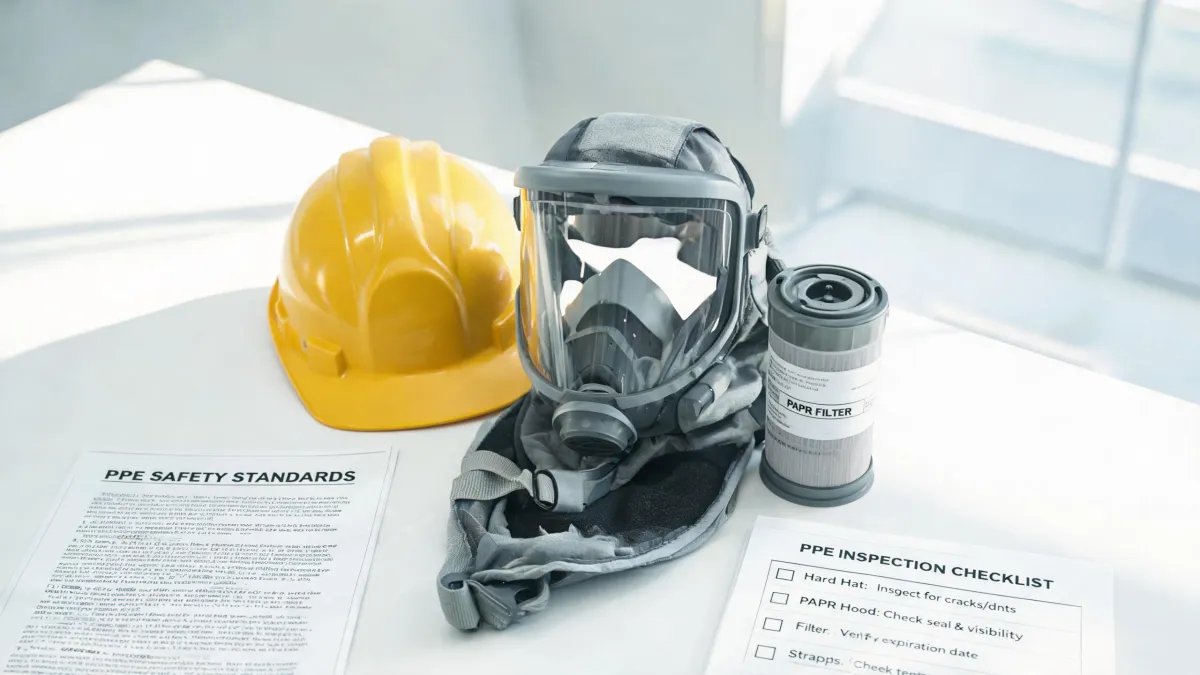
This is the most technically complex step, and I see the most errors here. If you're pairing a hard hat with a PAPR (like the Bullard 41 AF filter cartridge system), you can't just grab any hard hat and any respirator and snap them together.
Check Three Things:
- Mounting Interface: Does the hard hat have a dedicated PAPR mounting platform? The Bullard C30 has a specific crown mount for the PAPR hose. A generic hard hat might not have the slot for the hose guide or the bracket for the blower unit. Don't assume it fits. Verify.
- Filter Cartridge Type: The Bullard 41 AF filter cartridge is a NIOSH-approved P100 particulate filter. It's great for dusts, mists, and fumes (welding, grinding). But it is not an organic vapor cartridge. If you're around solvent vapors (paint booths, chemical labs), you need a cartridge that includes an organic vapor (OV) layer. Honest limitation: The 41 AF is a great particle filter, but I tell every customer: "If your primary hazard is chemical vapors, this isn't your filter." That builds trust. (Source: NIOSH approval documentation for Bullard 41 AF, effective 2024).
- Battery & Run Time: For welding or long shifts, verify the battery life is at least 8 hours. The Bullard PAPR system uses an 8-hour battery under normal load. In high-heat environments, that drops to about 6.5 hours. Plan your charging schedule accordingly. I learned that lesson after a team ran out of air at hour 7 (ugh).
Step 4: Do a Cost-of-Ownership Calculation (Not Just the Purchase Price)
Safety managers love to compare unit costs. I get it. But the real cost is the total expense over a year of use. Here's the formula I use:
Total Cost of Head Protection = (Unit Price ÷ Replacement Interval) + (Wage Cost per Hour × Downtime Minutes)
Let me give you a real example from a mid-size construction firm I audited (Q1 2024):
- Option A (Generic brand): $30 per unit, replace every 6 months. Downtime due to discomfort/complaints: ~15 minutes per person per week. Crew of 10, avg wage $30/hr. Annual cost = (30/0.5) + (10 × 0.25 hr × 30 × 52 weeks) = $60 + $3,900 = $3,960.
- Option B (Bullard C30): $60 per unit, replace every 2 years. Downtime: nearly zero after break-in. Annual cost = (60/2) + (0) = $30.
The difference is staggering. The real cost of a cheap hard hat is often in lost productivity due to discomfort. I've rejected initial orders from firms that bought the lowest bidder (unfortunately) because the spec didn't account for comfort. Don't be that person.
Step 5: Test for Fit and Retention (The 'Head-Shake' Test)
I end every hardware evaluation with a field test. You can't simulate this in a spec sheet. Put the hard hat on. Adjust the ratchet. Now, vigorously shake your head left to right, and up and down.
If the hard hat shifts more than half an inch, or if the suspension separates from the shell (I've seen this happen with defective units), reject it. This happened to us back in 2022. We had a batch of 200 units where the suspension clip was slightly undersized. On paper, it passed. In practice, after 10 minutes of pressure washing, the suspension popped out on 50 units. Cost us a $22,000 redo and a delayed launch.
Bullard's clip system (the C30 specifically) has a positive-lock retention. In my test, after 200 hard shakes, no separation. In a test of a competitor's model (not naming names), we saw separation after about 40 shakes in 20% of samples. That's a deal-breaker.
Common Mistakes (and What to Do Instead)
- Mistake: Assuming all hard hats fit all workers.
Fix: Order a size range (S/M, L/XL). The Bullard C30 comes in two sizes. Don't order only one size for a crew of 25. Trust me on this one. - Mistake: Not replacing suspension when hard hat is 'only a year old.'
Fix: Bullard recommends replacing the suspension every 12 months (or after any impact). Shells every 5 years per OSHA. Mark the date on the shell with a Sharpie. - Mistake: Mixing PAPR components from different brands.
Fix: Use only NIOSH-approved assembled systems. The Bullard 41 AF filter cartridge is designed for use with Bullard blowers only. Using it with a different blower would violate the NIOSH approval. Don't do it.
There's something satisfying about a perfectly executed PPE selection process. After all the paperwork and vendor calls, seeing a crew actually wear their gear comfortably—that's the payoff. Take it from someone who's rejected a ton of first-round samples on paper: following this checklist will save you a headache (and a lot of money).