-
Step 1: Confirm Certification Requirements First — Don’t Assume
-
Step 2: Evaluate Delivery Timeframes Honestly — Then Add a Buffer
-
Step 3: Choose a Supplier That Stocks What You Need — Not Just What They Sell
-
Step 4: Double-Check Accessories & Consumables — The Hidden Gotchas
-
Step 5: Verify Upon Arrival — Don’t Trust the Packing Slip Blindly
-
Common Mistakes I Still See (and How to Avoid Them)
When I first started managing PPE procurement for our industrial site, I assumed the lowest quote was always the best choice. Three budget overruns and one near-miss incident later, I learned that speed and certainty matter more than a few dollars saved — especially when you're up against a deadline.
If you’ve ever had to scramble for emergency PPE orders — a last-minute OSHA audit, a sudden crew expansion, or a critical site shutdown — you know that feeling of panic. You need Bullard Class E hard hats, a reliable PAPR respirator, maybe even a fire extinguisher trainer for tomorrow’s drill. The vendor says “probably by Friday.” That “probably” is what keeps me up at night.
Here’s a 5-step checklist I built after making — and documenting — seven significant mistakes over the past four years. It’s saved us roughly $4,000 in rework and delays. Use it the next time you’re ordering Bullard PPE under time pressure.
Step 1: Confirm Certification Requirements First — Don’t Assume
I once ordered 50 Bullard Class E hard hats for an electrical crew. Checked the item number twice, approved the PO. When they arrived, the hats met ANSI Z89.1 Type I standard — but not the Type II lateral impact required by our site contract. $1,800 down the drain because I didn’t double-check the spec.
What I should have done: pull the job site’s PPE matrix, then cross-reference with Bullard’s certification guides. For Class E (electrical) ratings, you need the hard hat to meet 20,000 volts of electrical protection. That’s not negotiable.
Take it from someone who wasted a week on re-shipping: always verify the required ANSI/CSA class before you even look at pricing. The extra phone call takes 5 minutes.
Step 2: Evaluate Delivery Timeframes Honestly — Then Add a Buffer
In September 2022, I needed a Bullard PAPR respirator system — the EVA model specifically for healthcare — for a new isolation unit that opened in 10 days. Vendor said “standard lead is 12 business days, but we can rush it to 7 for an extra $200.”
I thought: “What are the odds it’s really 7 days?” So I skipped the rush. The unit arrived on day 13. Missed the opening, got chewed out by the operations director. The $200 I saved cost the company $2,500 in overtime for temporary respirator rentals.
Now my rule: if the deadline is under 2 weeks, always pay for guaranteed delivery. Period. The rush fee buys certainty — not just speed. It’s an insurance premium against missing a real deadline.
Per USPS (usps.com) as of January 2025, a First-Class letter costs $0.73. But for a $3,000 Bullard PAPR system that needs to arrive by Friday, don’t gamble on standard shipping. Pay the expedite fee.
Step 3: Choose a Supplier That Stocks What You Need — Not Just What They Sell
I said “I need a Bullard PAPR respirator” to a distributor. They heard “any PAPR will do.” They delivered a different brand’s unit that wasn’t compatible with our existing Bullard facepieces. The result: a $1,200 return fee plus two weeks of confusion.
Here’s what you need to know: Bullard’s PAPR systems (like the EVA) are NIOSH-approved as complete assemblies. Using a non-Bullard blower with Bullard headgear voids the NIOSH certification. Always confirm the full part number and verify compatibility with your current inventory.
I now ask three questions before ordering:
- Is this a genuine Bullard part (not a third-party substitute)?
- Does the supplier maintain local stock for the exact model I need?
- Can they provide a written confirmation of shipping date within 1 hour?
If the answer to any is no, I move on. Seriously.
Step 4: Double-Check Accessories & Consumables — The Hidden Gotchas
I once ordered 20 Bullard bump caps for a warehouse team. Checked: caps, yes. But I forgot the replacement suspension kits and visor brackets. The caps arrived fine, but we couldn’t use them for 3 more days while the brackets shipped separately. $450 in wasted labor for a “completed” order that wasn’t complete.
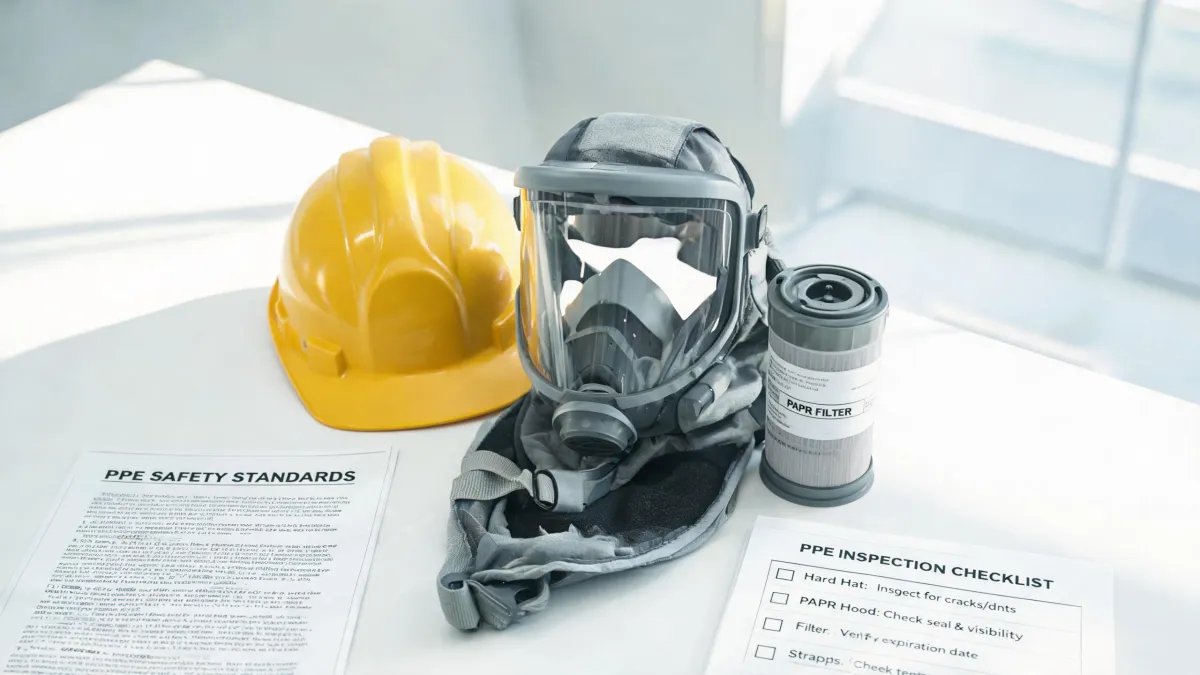
The lesson: when ordering Bullard PPE — whether it’s a Class E hard hat, a face shield, or a PAPR respirator — always add the accessories to the same order. Bullard part numbers often have suffix codes for accessories. For example, the Bullard EVA PAPR healthcare system usually ships with a breathing tube and headgear, but you might need extra filters or battery packs. Run through this checklist:
- ✔ Filters (for PAPR) or lens cartridges (for face shields)
- ✔ Suspension kits (hard hats and bump caps wear out every 1-3 years)
- ✔ Mounting brackets or adapter plates
- ✔ User manuals (are they digital or printed?)
I now use a template order form that lists every consumable item. Takes 2 minutes to fill out. Saves hours of back-and-forth.
Step 5: Verify Upon Arrival — Don’t Trust the Packing Slip Blindly
This one stings. October 2023: I received a shipment of Bullard hard hats. Packing slip said “20 ea. Bullard Class E hard hat, gray.” I signed. Opened the boxes at the job site — they were all yellow, not gray. The crew needed gray to match company colors. We had to repaint them (voiding the warranty) or reorder. $580 out the window.
Dodged a bullet once? Not really — I should have opened a sample box at the loading dock. Now my standard procedure:
- Open one box immediately and visually inspect color, labeling, and condition.
- Check the manufacturing date (hard hats and bump caps have a shelf life printed on the shell).
- For PAPR units, run a quick function test if possible.
If anything looks off, don’t accept the delivery. Call the supplier right there. Easier to fix before the pallet enters your warehouse.
Common Mistakes I Still See (and How to Avoid Them)
1. Assuming “CE” means “Class E.” CE certification is European. Class E is ANSI. Completely different. If you ask for “Class E hard hat” and get a CE-marked one, it may not offer the 20kV protection you need.
2. Ignoring battery compatibility for PAPR systems. The Bullard EVA PAPR uses specific battery packs. I’ve seen people order generic 18650s — they don’t fit, and they’re not certified for the unit. Stick to genuine Bullard accessories.
3. Forgetting about fire extinguisher recharging. If you use a Bullard fire extinguisher trainer for drills, remember that after training you need to properly recharge the extinguisher. Don’t skip that step — a discharged trainer is useless for next week’s safety audit. (The process is simple: use a refill kit and follow the manual. But it’s easy to forget until the trainer is empty.)
Honestly, the biggest mistake is thinking you can “figure it out later.” Later costs money. This checklist isn’t fancy. It’s just what works. Take it from someone who burned through $4,000 learning the hard way.